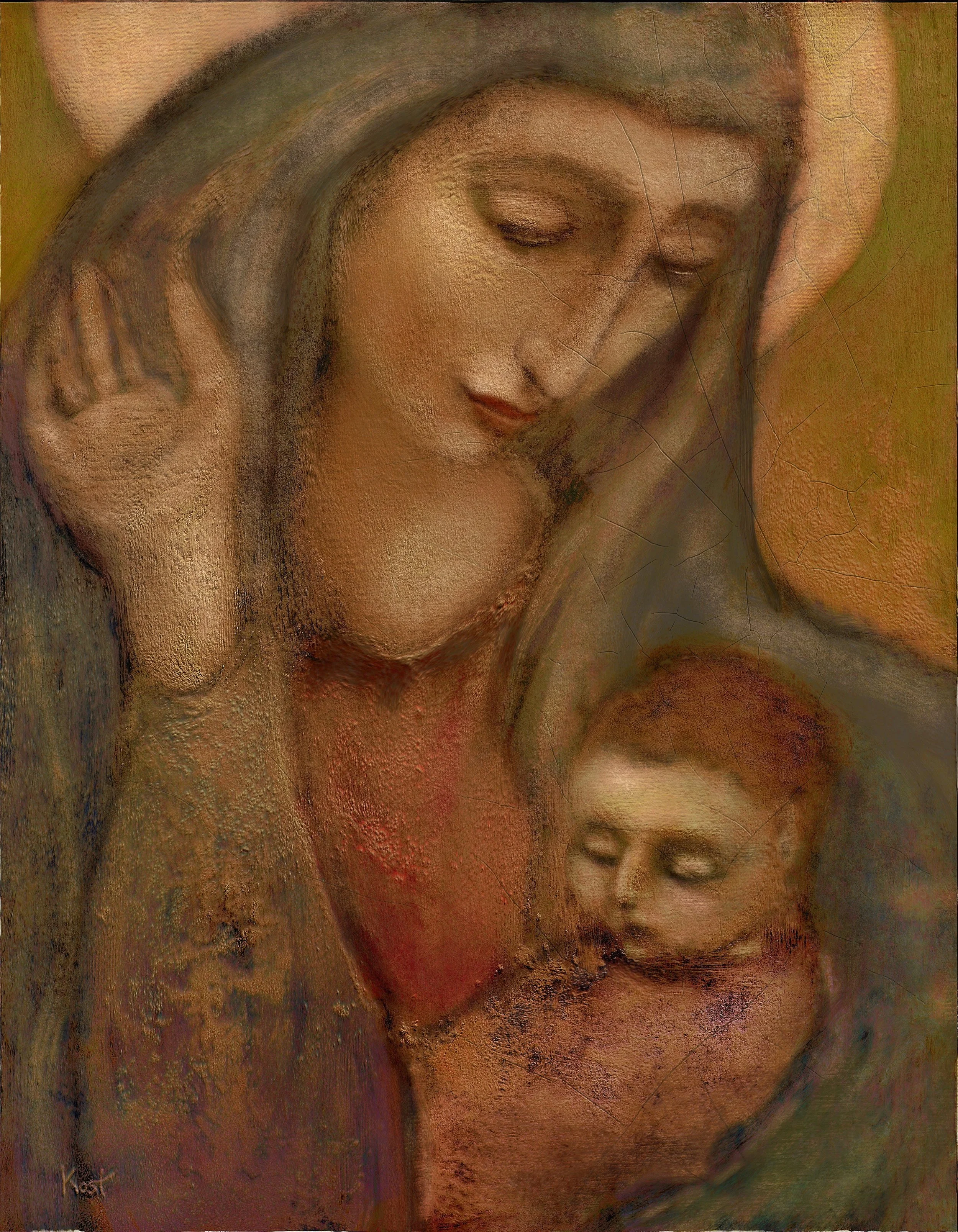
Mother and Child, Rome (2023-2025)
Archival Giclee print on 18”x24” heavyweight matte finish Hahnemühle German Etching Paper. This is a limited first edition hand-signed artwork.
This tender and hauntingly luminous digital painting, Mother and Child, Rome, evokes a rich continuum of Marian iconography while standing distinctly within the lineage of both classical sculpture and modern spiritual painting. Rooted in direct inspiration from an unnamed Vatican sculpture — perhaps one of the countless Renaissance or medieval devotional fragments housed within the Vatican Museums — this work transposes the tactile stillness of carved stone into a warm, breathing register of digital texture.
The Virgin’s gesture, with her hand gently raised in a muted or perhaps silenced blessing, suggests both benediction and resignation — a theologically potent ambiguity reminiscent of Byzantine icons and echoed centuries later in the hand gestures of da Vinci’s The Virgin of the Rocks or his unfinished Madonna and Child with St. Anne. Like da Vinci, Kost explores the psychological interiority of Mary without disrupting the formal dignity of her archetype. Her downcast eyes and veiled sorrow invite quiet contemplation, not theatrical sentiment — a restraint deeply embedded in the spiritual visual language of the Renaissance.
Kost’s rendering of the Madonna’s face—elongated, softly modeled, shadowed with an otherworldly gravity—draws distinct comparison to the sfumato of Leonardo. Yet it also gestures toward the cooler tonal restraint of Fra Angelico and the velvet hush of Antonello da Messina. The worn, eroded surface textures within the piece suggest not decay, but time-transcendence — the image as relic, unearthed from centuries of devotional touch or candle smoke. The subtle, matte graininess reads like polychrome dust on marble, amplifying the sense that this is not a representation but a memory of a sculpture.
The Christ Child, notably silent and inward, departs from the playful or triumphant depictions of the bambino in Italian High Renaissance art. Here, He appears wrapped in profound interior silence, his eyes closed, head bowed — a foreshadowing of the Passion, perhaps, but also an image of peace, as if slumbering within a deeper, divine knowledge. The emotional distance between the figures — a hallmark of Byzantine iconography — heightens their sacredness. Yet this distance is bridged through their shared softness of form, their unity of hue, and the enveloping cloak that subtly binds their forms together, visually and symbolically.
In this work, the artist does not seek to replicate the divine through literalism, but instead through evocation — the echo of divine encounter rather than its depiction. The tonal palette, dominated by warm umbers, earthy mauves, and scorched sienna, imbues the work with a relic-like aura, calling to mind the waxy patina of medieval encaustic icons and the burnished stone of ancient catacomb frescoes. It is deeply Roman in its earthiness and deeply Marian in its spiritual hush.
There are resonances, too, with the mystical distortions of Georges Rouault or the weathered surface sanctity of Odilon Redon’s later works — artists who, like Kost, pursued the sacred image not through clarity but through mystery. The decision to render this piece digitally yet with such palpably organic textures speaks to Kost’s broader project: reclaiming the sacred in a contemporary world, using the very tools of modernity to express a longing for what has been spiritually forgotten.
Ultimately, Mother and Child, Rome is not simply a depiction — it is a devotion. A still, aching prayer encoded in digital brush and finger-swept shadow. Through its restrained composition, eroded surface, and theological nuance, it becomes not just a tribute to a Vatican sculpture, but a new relic of interior faith — contemporary, ancient, and eternal all at once.
Archival Giclee print on 18”x24” heavyweight matte finish Hahnemühle German Etching Paper. This is a limited first edition hand-signed artwork.
This tender and hauntingly luminous digital painting, Mother and Child, Rome, evokes a rich continuum of Marian iconography while standing distinctly within the lineage of both classical sculpture and modern spiritual painting. Rooted in direct inspiration from an unnamed Vatican sculpture — perhaps one of the countless Renaissance or medieval devotional fragments housed within the Vatican Museums — this work transposes the tactile stillness of carved stone into a warm, breathing register of digital texture.
The Virgin’s gesture, with her hand gently raised in a muted or perhaps silenced blessing, suggests both benediction and resignation — a theologically potent ambiguity reminiscent of Byzantine icons and echoed centuries later in the hand gestures of da Vinci’s The Virgin of the Rocks or his unfinished Madonna and Child with St. Anne. Like da Vinci, Kost explores the psychological interiority of Mary without disrupting the formal dignity of her archetype. Her downcast eyes and veiled sorrow invite quiet contemplation, not theatrical sentiment — a restraint deeply embedded in the spiritual visual language of the Renaissance.
Kost’s rendering of the Madonna’s face—elongated, softly modeled, shadowed with an otherworldly gravity—draws distinct comparison to the sfumato of Leonardo. Yet it also gestures toward the cooler tonal restraint of Fra Angelico and the velvet hush of Antonello da Messina. The worn, eroded surface textures within the piece suggest not decay, but time-transcendence — the image as relic, unearthed from centuries of devotional touch or candle smoke. The subtle, matte graininess reads like polychrome dust on marble, amplifying the sense that this is not a representation but a memory of a sculpture.
The Christ Child, notably silent and inward, departs from the playful or triumphant depictions of the bambino in Italian High Renaissance art. Here, He appears wrapped in profound interior silence, his eyes closed, head bowed — a foreshadowing of the Passion, perhaps, but also an image of peace, as if slumbering within a deeper, divine knowledge. The emotional distance between the figures — a hallmark of Byzantine iconography — heightens their sacredness. Yet this distance is bridged through their shared softness of form, their unity of hue, and the enveloping cloak that subtly binds their forms together, visually and symbolically.
In this work, the artist does not seek to replicate the divine through literalism, but instead through evocation — the echo of divine encounter rather than its depiction. The tonal palette, dominated by warm umbers, earthy mauves, and scorched sienna, imbues the work with a relic-like aura, calling to mind the waxy patina of medieval encaustic icons and the burnished stone of ancient catacomb frescoes. It is deeply Roman in its earthiness and deeply Marian in its spiritual hush.
There are resonances, too, with the mystical distortions of Georges Rouault or the weathered surface sanctity of Odilon Redon’s later works — artists who, like Kost, pursued the sacred image not through clarity but through mystery. The decision to render this piece digitally yet with such palpably organic textures speaks to Kost’s broader project: reclaiming the sacred in a contemporary world, using the very tools of modernity to express a longing for what has been spiritually forgotten.
Ultimately, Mother and Child, Rome is not simply a depiction — it is a devotion. A still, aching prayer encoded in digital brush and finger-swept shadow. Through its restrained composition, eroded surface, and theological nuance, it becomes not just a tribute to a Vatican sculpture, but a new relic of interior faith — contemporary, ancient, and eternal all at once.