Fracture (2023-2026)
Archival Giclee print on 18”x24” heavyweight matte finish Hahnemühle German Etching Paper. This is a limited first edition hand-signed artwork.
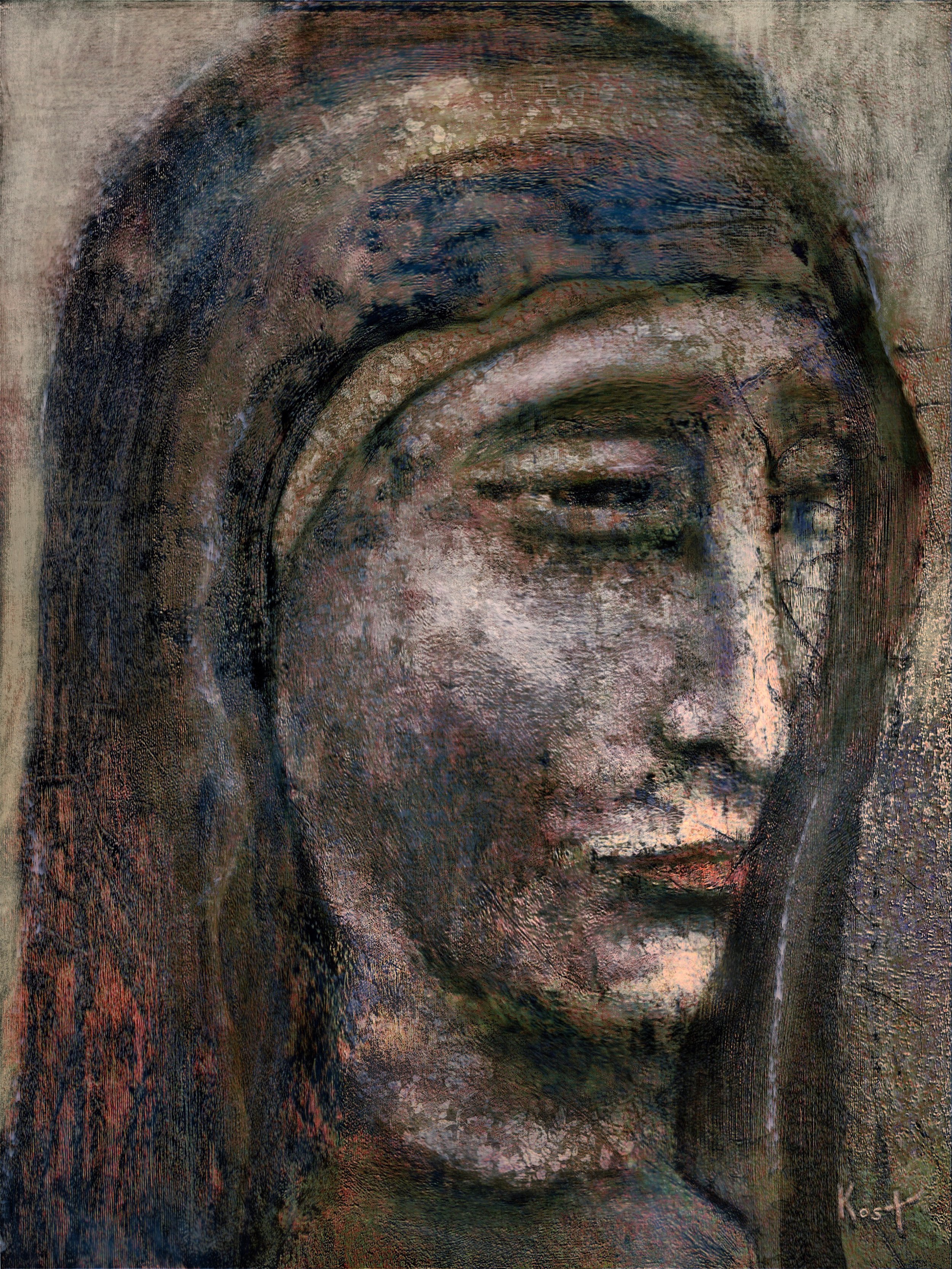
Fracture presents itself as both image and relic—less a portrait than an excavation. At first glance, the face emerges with the quiet authority of a sacred icon, yet it resists clarity, as if time itself has partially erased it. The result is a surface that feels unearthed rather than painted: something discovered in fragments, suspended between revelation and disappearance.
Formally, the composition is anchored in the visual language of Byzantine iconography, particularly in the elongated facial structure, the downward gaze, and the stillness of expression. These are not merely stylistic echoes—they function as conceptual scaffolding. In traditional icons, the face is not a likeness but a threshold, a site through which the divine becomes perceptible. Here, that threshold has been destabilized. The features are softened, blurred, almost dissolving into the surrounding field. The eye, in particular, appears partially obscured, as if vision itself has been interrupted or withdrawn.
The surface treatment is where the work achieves its greatest complexity. The texture evokes aged plaster, oxidized metal, or a weathered fresco—materials historically associated with endurance and sacred space. Yet this “patina” is digitally constructed, creating a productive tension between ancient material memory and contemporary technique. In this sense, the work aligns with broader tendencies in contemporary art that revisit historical forms through digital means, but it does so with unusual restraint. Rather than appropriating the past for aesthetic effect, it interrogates the conditions under which meaning survives at all.
There is also a subtle but persistent sense of erosion—not only physical but metaphysical. The face seems to be both forming and dissolving simultaneously, caught in a state of ontological uncertainty. This places the work in dialogue with traditions of Renaissance sfumato, where edges dissolve into atmosphere, but here the effect is more existential than optical. It is not just the boundary between forms that is blurred, but the boundary between presence and absence.
Emotionally, the image operates in a register of quiet gravity. The expression is neither overtly sorrowful nor serene; it inhabits a more ambiguous space—what might be described as contemplative endurance. This ambiguity is crucial. It prevents the work from collapsing into sentimentality and instead opens it to a wider field of interpretation. The viewer is not told what to feel but is invited into a slower, more attentive mode of looking.
In the context of contemporary image culture—defined by speed, clarity, and excess—the work functions almost as a counter-image. It withholds resolution. It demands duration. Where most images seek immediate legibility, this one insists on opacity, on the idea that meaning is not given but approached gradually, and perhaps never fully attained.
Ultimately, this piece can be understood as an exploration of memory—personal, cultural, and spiritual. It asks what remains when images are stripped of their immediacy, when they are subjected to time, decay, and reinterpretation. The answer it offers is not definitive, but it is compelling: what remains is not clarity, but resonance. Not the image itself, but the trace of its presence.
In this way, the work does not simply depict a face; it stages an encounter—with history, with loss, and with the enduring human impulse to seek meaning within both.
Archival Giclee print on 18”x24” heavyweight matte finish Hahnemühle German Etching Paper. This is a limited first edition hand-signed artwork.
Fracture presents itself as both image and relic—less a portrait than an excavation. At first glance, the face emerges with the quiet authority of a sacred icon, yet it resists clarity, as if time itself has partially erased it. The result is a surface that feels unearthed rather than painted: something discovered in fragments, suspended between revelation and disappearance.
Formally, the composition is anchored in the visual language of Byzantine iconography, particularly in the elongated facial structure, the downward gaze, and the stillness of expression. These are not merely stylistic echoes—they function as conceptual scaffolding. In traditional icons, the face is not a likeness but a threshold, a site through which the divine becomes perceptible. Here, that threshold has been destabilized. The features are softened, blurred, almost dissolving into the surrounding field. The eye, in particular, appears partially obscured, as if vision itself has been interrupted or withdrawn.
The surface treatment is where the work achieves its greatest complexity. The texture evokes aged plaster, oxidized metal, or a weathered fresco—materials historically associated with endurance and sacred space. Yet this “patina” is digitally constructed, creating a productive tension between ancient material memory and contemporary technique. In this sense, the work aligns with broader tendencies in contemporary art that revisit historical forms through digital means, but it does so with unusual restraint. Rather than appropriating the past for aesthetic effect, it interrogates the conditions under which meaning survives at all.
There is also a subtle but persistent sense of erosion—not only physical but metaphysical. The face seems to be both forming and dissolving simultaneously, caught in a state of ontological uncertainty. This places the work in dialogue with traditions of Renaissance sfumato, where edges dissolve into atmosphere, but here the effect is more existential than optical. It is not just the boundary between forms that is blurred, but the boundary between presence and absence.
Emotionally, the image operates in a register of quiet gravity. The expression is neither overtly sorrowful nor serene; it inhabits a more ambiguous space—what might be described as contemplative endurance. This ambiguity is crucial. It prevents the work from collapsing into sentimentality and instead opens it to a wider field of interpretation. The viewer is not told what to feel but is invited into a slower, more attentive mode of looking.
In the context of contemporary image culture—defined by speed, clarity, and excess—the work functions almost as a counter-image. It withholds resolution. It demands duration. Where most images seek immediate legibility, this one insists on opacity, on the idea that meaning is not given but approached gradually, and perhaps never fully attained.
Ultimately, this piece can be understood as an exploration of memory—personal, cultural, and spiritual. It asks what remains when images are stripped of their immediacy, when they are subjected to time, decay, and reinterpretation. The answer it offers is not definitive, but it is compelling: what remains is not clarity, but resonance. Not the image itself, but the trace of its presence.
In this way, the work does not simply depict a face; it stages an encounter—with history, with loss, and with the enduring human impulse to seek meaning within both.