Mother and Child, Ukraine (2022-2024)
Archival Giclee print on 18”x24” heavyweight matte finish Hahnemühle German Etching Paper. This is a limited first edition hand-signed artwork.
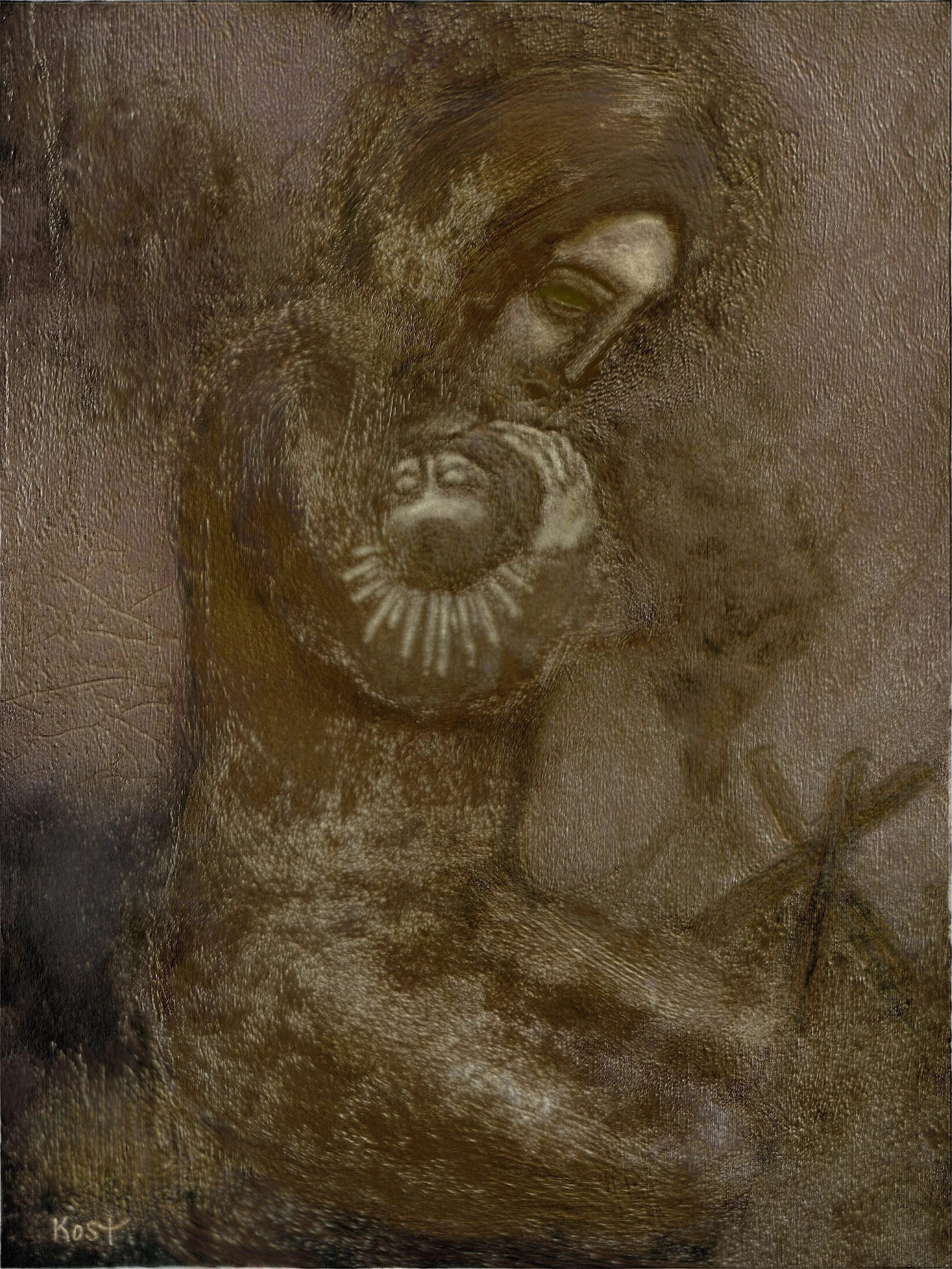
In Mother and Child, Ukraine, Kost offers a harrowing reinterpretation of the age-old motif of maternal lamentation, drawing solemn inspiration from Michelangelo’s Pietà while transposing its sacred stillness into the scorched reality of contemporary war. This is not the marble serenity of Renaissance devotion, but a scene trembling with anguish—a mother cradling the limp form of her child amid the ruin of open fields, their bodies exposed to wind, dust, and the unrelenting machinery of violence.
The digital surface, drawn entirely with the artist’s fingers, possesses the immediacy of a battlefield sketch—unfinished, raw, almost fragile in its facture. Lines waver and dissolve as though the image itself cannot withstand the weight of what it records. This sketch-like impermanence becomes a theological gesture in its own right: mirroring the instability of life during war, the way grief resists resolution, and how maternal love persists even in the face of annihilation.
Where Renaissance art sought idealized beauty, Kost offers unvarnished truth. The mother’s posture—a fusion of tenderness and devastation—bears the weight not only of her own suffering, but of all who have been forced to carry loss through smoke and ash. Her downturned face, her arm encircling the limp child, evokes not only the Pietà but also the anguished Madonnas of Eastern iconography, especially those seen in Ukrainian roadside shrines—figures that bear witness in silence.
The barren landscape into which the figures are set is not a backdrop but an active, accusatory presence: broken earth, skeletal vegetation, a field emptied of life. It is both literal and metaphorical—a terrain of mourning that could belong equally to Donbas, to Syria, to any land where innocence has been sacrificed. The visual sparseness intensifies the emotional density; it is what isn’t there—shelter, community, peace—that speaks loudest.
This work aligns itself with a long lineage of artistic witness: from Goya’s Disasters of Warto Käthe Kollwitz’s Mother and Dead Child, to Picasso’s Guernica. And yet, it is unmistakably of our time. Rooted specifically in the war-torn Donbas region, it bears the geopolitical particularity of ongoing conflict while still offering an image that transcends its location. The mother becomes not a single figure, but an icon of the countless women who have buried children in wars never of their choosing.
But what distinguishes Mother and Child, Ukraine is not its depiction of violence, but its restraint—its refusal to sensationalize suffering. Kost presents devastation not as spectacle, but as sacrament. There is no gore, only silence. No blood, only dust. It is in this restraint that the work’s spiritual gravity emerges: a holy lamentation made digital, ephemeral, and yet, enduring.
In rendering the most vulnerable in the most forsaken of places, Kost positions the image not only as a portrait of grief, but as a liturgical act. To view this work is to participate in mourning; to remember those whom the world forgets; to carry, if only for a moment, the unbearable weight of another’s loss.
This is not simply a work of art. It is a witness.
Archival Giclee print on 18”x24” heavyweight matte finish Hahnemühle German Etching Paper. This is a limited first edition hand-signed artwork.
In Mother and Child, Ukraine, Kost offers a harrowing reinterpretation of the age-old motif of maternal lamentation, drawing solemn inspiration from Michelangelo’s Pietà while transposing its sacred stillness into the scorched reality of contemporary war. This is not the marble serenity of Renaissance devotion, but a scene trembling with anguish—a mother cradling the limp form of her child amid the ruin of open fields, their bodies exposed to wind, dust, and the unrelenting machinery of violence.
The digital surface, drawn entirely with the artist’s fingers, possesses the immediacy of a battlefield sketch—unfinished, raw, almost fragile in its facture. Lines waver and dissolve as though the image itself cannot withstand the weight of what it records. This sketch-like impermanence becomes a theological gesture in its own right: mirroring the instability of life during war, the way grief resists resolution, and how maternal love persists even in the face of annihilation.
Where Renaissance art sought idealized beauty, Kost offers unvarnished truth. The mother’s posture—a fusion of tenderness and devastation—bears the weight not only of her own suffering, but of all who have been forced to carry loss through smoke and ash. Her downturned face, her arm encircling the limp child, evokes not only the Pietà but also the anguished Madonnas of Eastern iconography, especially those seen in Ukrainian roadside shrines—figures that bear witness in silence.
The barren landscape into which the figures are set is not a backdrop but an active, accusatory presence: broken earth, skeletal vegetation, a field emptied of life. It is both literal and metaphorical—a terrain of mourning that could belong equally to Donbas, to Syria, to any land where innocence has been sacrificed. The visual sparseness intensifies the emotional density; it is what isn’t there—shelter, community, peace—that speaks loudest.
This work aligns itself with a long lineage of artistic witness: from Goya’s Disasters of Warto Käthe Kollwitz’s Mother and Dead Child, to Picasso’s Guernica. And yet, it is unmistakably of our time. Rooted specifically in the war-torn Donbas region, it bears the geopolitical particularity of ongoing conflict while still offering an image that transcends its location. The mother becomes not a single figure, but an icon of the countless women who have buried children in wars never of their choosing.
But what distinguishes Mother and Child, Ukraine is not its depiction of violence, but its restraint—its refusal to sensationalize suffering. Kost presents devastation not as spectacle, but as sacrament. There is no gore, only silence. No blood, only dust. It is in this restraint that the work’s spiritual gravity emerges: a holy lamentation made digital, ephemeral, and yet, enduring.
In rendering the most vulnerable in the most forsaken of places, Kost positions the image not only as a portrait of grief, but as a liturgical act. To view this work is to participate in mourning; to remember those whom the world forgets; to carry, if only for a moment, the unbearable weight of another’s loss.
This is not simply a work of art. It is a witness.