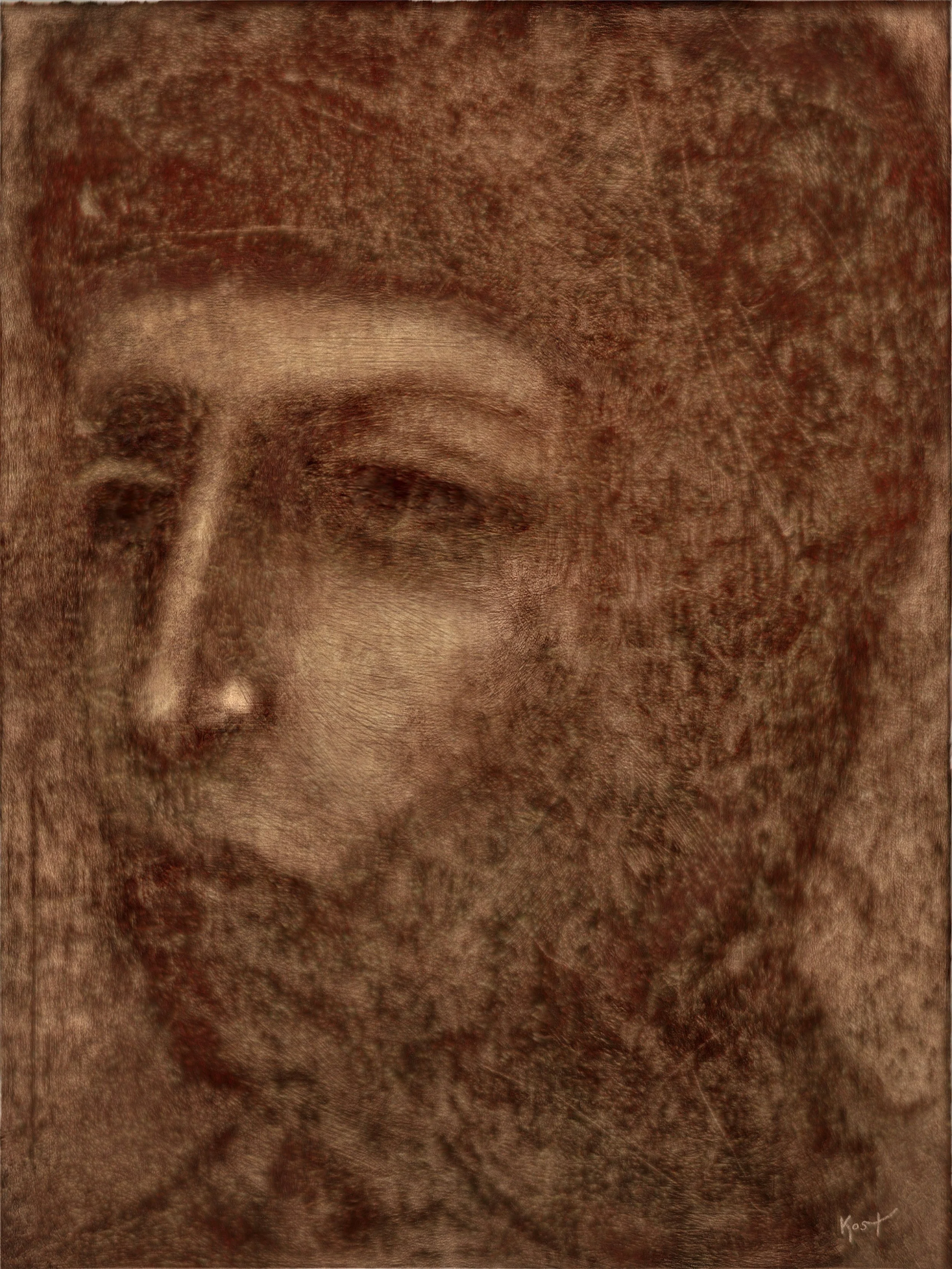
Joan, Orleans (2023-2025)
Archival Giclee print on 18”x24” heavyweight matte finish Hahnemühle German Etching Paper. This is a limited first edition hand-signed artwork.
In Joan, Orleans, Kost renders a vision of Saint Joan of Arc that is at once veiled and monumental, spectral and incarnate. Rather than relying on overt historicism or illustrative clarity, he envelops the warrior-saint in a shroud of textured earth tones—iron-rich browns, burnished ochres, and blooded siennas—that evoke both sacred relic and scorched battlefield. Joan’s face emerges slowly from the image’s fibrous surface, her gaze turned inward, perhaps listening—as she once did—to divine voices no one else could hear.
Though abstracted, the presence of armor is unmistakable. It encases her not with shine, but with the density of ash and silence. Kost avoids the shiny, heroic look of traditional armor. Instead, Joan’s figure is shaped through shadows, rough textures, and a deep, heavy presence. Her armor doesn’t just protect her body—it feels sacred, like a spiritual shell formed through faith and suffering.
The materiality of the image—the bruised, sedimentary texture—echoes the medieval reality of battle and martyrdom, yet the composition lifts Joan beyond time. She is not shown mid-victory or at the stake, but in a moment of profound stillness, suspended between duty and obliteration.
Kost’s rendering participates in a long lineage of Christian iconography while resisting its traditional clarity. The face is both present and receding, suggesting the sacramental paradox of Joan herself: woman and warrior, peasant and prophet, child and saint. The armor she wears is not rendered in sharp, metallic terms but as a second skin—weathered, indistinguishable at points from her own flesh, as if her very body had become a vessel for divine militancy.
In theological terms, this is Joan as Theotokos of Resistance: armored not just in steel, but in faith, anguish, and fire. The work reverberates with the tradition of apophatic mysticism, in which true knowledge of the holy comes through obscurity and absence. Her partial effacement invites the viewer not to behold her as object, but to approach her as mystery.
This is not a Joan triumphant, but a Joan transfigured—drawn in the language of silence, dust, and embered light. She stands as a spiritual palimpsest: the saint whose legacy survives the flame, whose armor was both burden and blessing, and whose presence, even in abstraction, testifies to the divine amid a world of smoke and betrayal.
Drawing inspiration from the sketches of Leonardo da Vinci, this depiction of Joan of Arc engages with his distinctive approach to line, form, and expressive immediacy. Through this stylistic exploration, the work seeks to capture not only the historical figure’s resilience and determination but also a deeply personal connection to these qualities.
To Kost, Joan of Arc’s unwavering strength, courage, and perseverance serve as a visual and symbolic parallel to the endurance of a very dear loved one navigating the profound challenges of recovery from a traumatic brain injury and illness. Joan is the perfect symbol for her. In this way, the artwork functions as both an homage to the past and a meditation on contemporary struggles of resilience and survival.
Archival Giclee print on 18”x24” heavyweight matte finish Hahnemühle German Etching Paper. This is a limited first edition hand-signed artwork.
In Joan, Orleans, Kost renders a vision of Saint Joan of Arc that is at once veiled and monumental, spectral and incarnate. Rather than relying on overt historicism or illustrative clarity, he envelops the warrior-saint in a shroud of textured earth tones—iron-rich browns, burnished ochres, and blooded siennas—that evoke both sacred relic and scorched battlefield. Joan’s face emerges slowly from the image’s fibrous surface, her gaze turned inward, perhaps listening—as she once did—to divine voices no one else could hear.
Though abstracted, the presence of armor is unmistakable. It encases her not with shine, but with the density of ash and silence. Kost avoids the shiny, heroic look of traditional armor. Instead, Joan’s figure is shaped through shadows, rough textures, and a deep, heavy presence. Her armor doesn’t just protect her body—it feels sacred, like a spiritual shell formed through faith and suffering.
The materiality of the image—the bruised, sedimentary texture—echoes the medieval reality of battle and martyrdom, yet the composition lifts Joan beyond time. She is not shown mid-victory or at the stake, but in a moment of profound stillness, suspended between duty and obliteration.
Kost’s rendering participates in a long lineage of Christian iconography while resisting its traditional clarity. The face is both present and receding, suggesting the sacramental paradox of Joan herself: woman and warrior, peasant and prophet, child and saint. The armor she wears is not rendered in sharp, metallic terms but as a second skin—weathered, indistinguishable at points from her own flesh, as if her very body had become a vessel for divine militancy.
In theological terms, this is Joan as Theotokos of Resistance: armored not just in steel, but in faith, anguish, and fire. The work reverberates with the tradition of apophatic mysticism, in which true knowledge of the holy comes through obscurity and absence. Her partial effacement invites the viewer not to behold her as object, but to approach her as mystery.
This is not a Joan triumphant, but a Joan transfigured—drawn in the language of silence, dust, and embered light. She stands as a spiritual palimpsest: the saint whose legacy survives the flame, whose armor was both burden and blessing, and whose presence, even in abstraction, testifies to the divine amid a world of smoke and betrayal.
Drawing inspiration from the sketches of Leonardo da Vinci, this depiction of Joan of Arc engages with his distinctive approach to line, form, and expressive immediacy. Through this stylistic exploration, the work seeks to capture not only the historical figure’s resilience and determination but also a deeply personal connection to these qualities.
To Kost, Joan of Arc’s unwavering strength, courage, and perseverance serve as a visual and symbolic parallel to the endurance of a very dear loved one navigating the profound challenges of recovery from a traumatic brain injury and illness. Joan is the perfect symbol for her. In this way, the artwork functions as both an homage to the past and a meditation on contemporary struggles of resilience and survival.