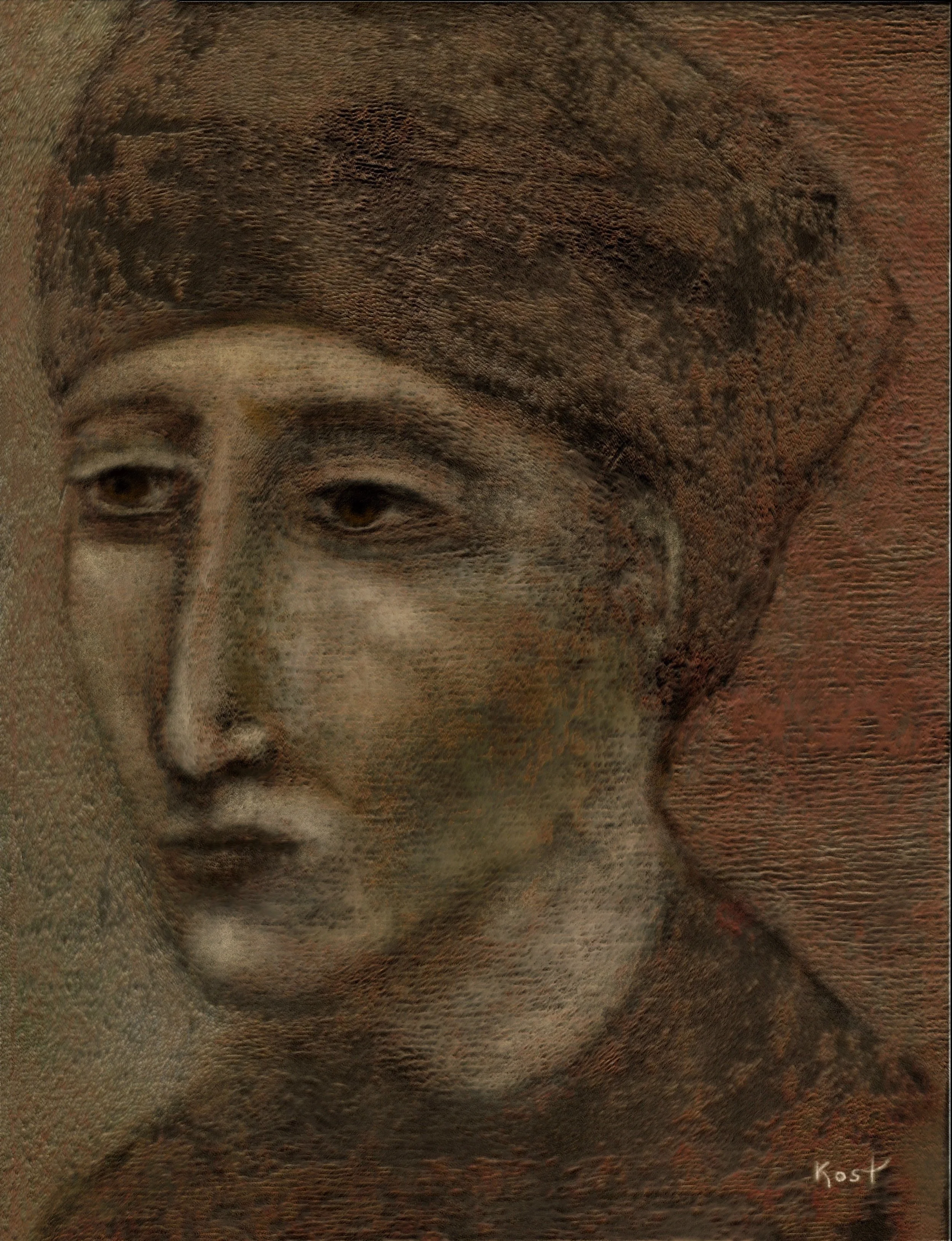
The Whisper (2024-2025)
Archival Giclee print on 18”x24” heavyweight matte finish Hahnemühle German Etching Paper. This is a limited first edition hand-signed artwork.
Erik Kost’s The Whisper is a hauntingly tender portrayal of spiritual interiority, evoking the ancient visual language of Byzantine iconography while subtly subverting its conventions through modern, digital means. The figure, quietly emerging from a weathered, earthen-toned field, wears an expression of hushed sorrow and sacred contemplation. Their gaze—averted yet inwardly alive—suggests the silent transmission of divine knowledge, grief, or memory: the whisper that passes not through the ears, but through the soul.
Visually, the work conjures echoes of Paleologan-era icons, where the psychological depth of saints began to shift from formalized holiness to something more inward and existential. The elongated nose, heavily lidded eyes, and restrained tonality recall the devotional pathos of early icons found in Mount Sinai or Ohrid. And yet, the work also gestures toward the atmospheric austerity of early Italian fresco—Giotto’s Lamentation or Cimabue’s Madonnas, stripped of embellishment and saturated with humanity.
Executed entirely with the artist’s fingers on a digital platform, The Whisper achieves a paradoxical fusion: it feels both unearthed and unborn, as if it were an ancient fragment digitally exhumed from the ruins of a forgotten chapel. The texture—reminiscent of decayed wall plaster or scorched vellum—resists the smooth precision typical of digital media, instead inviting the viewer into a realm of intimate imperfection and sacred erosion. The whisper here is not only in the figure’s closed lips but in the way the image itself seems to murmur from beneath centuries of silence.
Art historically, the piece sits at the interstice between Byzantine spiritual formality and the introspective solitude of Northern Renaissance portraiture. One might hear distant echoes of Rogier van der Weyden’s ethereal saints or even the mournful gravity of Dürer’s Melencolia I, though stripped of allegory and rendered as raw presence. But unlike these historical referents, Kost offers no narrative or iconographic symbols—only a face, a shadow, and a silence that speaks.
What makes The Whisper quietly groundbreaking is not merely its synthesis of digital technique with historical form, but its invocation of the sacred through reduction. This is not an icon in the traditional sense, but an invocation—a relic not of a known saint, but of an unnamed suffering, a forgotten prayer, or the quiet persistence of the soul in exile.
Archival Giclee print on 18”x24” heavyweight matte finish Hahnemühle German Etching Paper. This is a limited first edition hand-signed artwork.
Erik Kost’s The Whisper is a hauntingly tender portrayal of spiritual interiority, evoking the ancient visual language of Byzantine iconography while subtly subverting its conventions through modern, digital means. The figure, quietly emerging from a weathered, earthen-toned field, wears an expression of hushed sorrow and sacred contemplation. Their gaze—averted yet inwardly alive—suggests the silent transmission of divine knowledge, grief, or memory: the whisper that passes not through the ears, but through the soul.
Visually, the work conjures echoes of Paleologan-era icons, where the psychological depth of saints began to shift from formalized holiness to something more inward and existential. The elongated nose, heavily lidded eyes, and restrained tonality recall the devotional pathos of early icons found in Mount Sinai or Ohrid. And yet, the work also gestures toward the atmospheric austerity of early Italian fresco—Giotto’s Lamentation or Cimabue’s Madonnas, stripped of embellishment and saturated with humanity.
Executed entirely with the artist’s fingers on a digital platform, The Whisper achieves a paradoxical fusion: it feels both unearthed and unborn, as if it were an ancient fragment digitally exhumed from the ruins of a forgotten chapel. The texture—reminiscent of decayed wall plaster or scorched vellum—resists the smooth precision typical of digital media, instead inviting the viewer into a realm of intimate imperfection and sacred erosion. The whisper here is not only in the figure’s closed lips but in the way the image itself seems to murmur from beneath centuries of silence.
Art historically, the piece sits at the interstice between Byzantine spiritual formality and the introspective solitude of Northern Renaissance portraiture. One might hear distant echoes of Rogier van der Weyden’s ethereal saints or even the mournful gravity of Dürer’s Melencolia I, though stripped of allegory and rendered as raw presence. But unlike these historical referents, Kost offers no narrative or iconographic symbols—only a face, a shadow, and a silence that speaks.
What makes The Whisper quietly groundbreaking is not merely its synthesis of digital technique with historical form, but its invocation of the sacred through reduction. This is not an icon in the traditional sense, but an invocation—a relic not of a known saint, but of an unnamed suffering, a forgotten prayer, or the quiet persistence of the soul in exile.