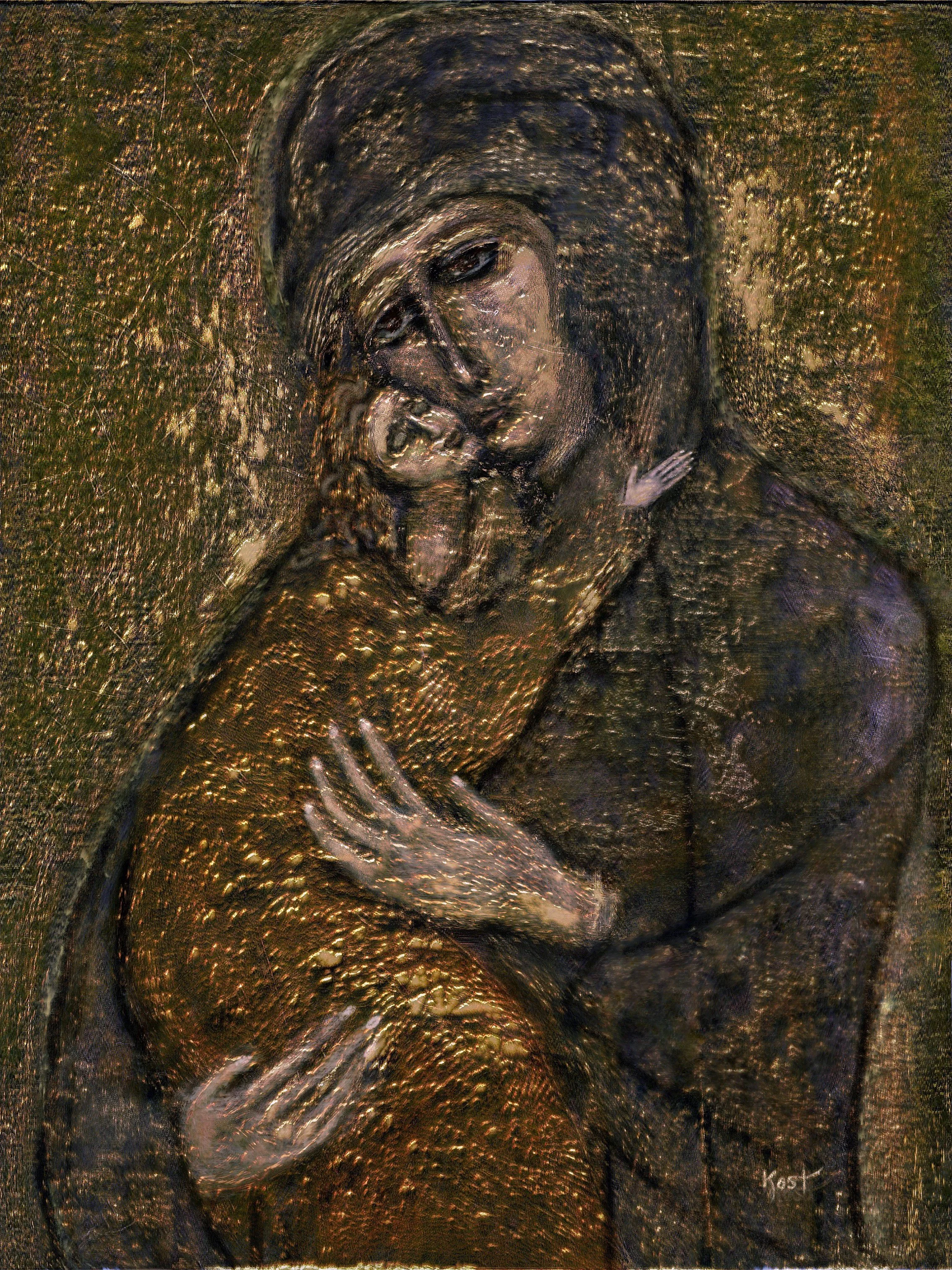
Mother and Child, Kyiv (2022-2025)
Archival Giclee print on 18”x24” heavyweight matte finish Hahnemühle German Etching Paper. This is a limited first edition hand-signed artwork.
Mother and Child, Kyiv is a contemporary sacred image that reverberates with the sorrow and sanctity of both ancient tradition and present-day trauma. Rendered with poignant restraint, the figures of a mother and her child are locked in a timeless embrace—cheeks pressed tenderly together, hands cradling the fragile space between love and grief. Though unmistakably rooted in the visual language of Eastern Christian iconography, this image carries the soul of a modern lamentation.
Inspired in part by ancient Ukrainian Marian icons—particularly those from the Kyivan Rus’ tradition—Kost’s digital work resurrects the Eleousa or “Virgin of Tenderness” archetype, but does so through a deeply personal and historically conscious lens. The Madonna’s expression is worn and grave, her love protective yet shadowed by suffering. The child presses into her not with naïve joy, but with solemn dependence, as if aware of the trials to come.
The work is entirely finger-painted in the digital medium, lending it a tactile quality that echoes the devotional intimacy of hand-painted icons. The surface texture—layered, weathered, gold-flecked—evokes the patina of time-worn sacred panels, fresco remnants, or painted wood exposed to generations of prayer, war, and survival.
Stylistic Context
Mother and Child, Kyiv stands in conversation with the great devotional traditions of Byzantine and Kyivan iconography, while also drawing spiritual and emotional energy from modern expressionist painters. The flattened faces, elongated features, and hieratic stillness recall the sacred figures of St. Sophia Cathedral in Kyiv or icons from the Pechersk Lavra, yet the emotional intimacy and gentle asymmetry connect it with the Western humanism of Duccio, and the spiritual melancholy of Rouault, Kollwitz, and Chagall.
The palette—a restrained blend of muted gold, earthen brown, and soft plum—mimics both medieval egg tempera and aged encaustic, grounding the work in history even as it emerges through digital means. The technique recalls Antoni Tàpies’ spiritual materialism, where texture and touch become a kind of sacred language.
Kost avoids sentimentality, choosing instead a mood of quiet endurance—a Marian presence shaped as much by history as by theology.
Thematic and Historical Context
This is not merely an icon of Christ and His mother—it is a spiritual lament for Ukraine, and for all mothers and children marked by displacement, war, and the ache of intergenerational grief. As a first-generation Ukrainian American, Kost draws on a deep ancestral memory: the holy images carried through exile, the whispered prayers in darkened homes, and the sorrow held in the arms of every mother who has lost a homeland or a child.
Mother and Child, Kyiv is a sacred witness to that reality. The tenderness here is not naïve—it is redemptive, forged through suffering. The closeness between the figures mirrors the closeness between heaven and earth in Orthodox theology, where icons are not mere art, but portals into eternity. And yet, here, that eternity is also marked by trauma, resilience, and remembrance.
Archival Giclee print on 18”x24” heavyweight matte finish Hahnemühle German Etching Paper. This is a limited first edition hand-signed artwork.
Mother and Child, Kyiv is a contemporary sacred image that reverberates with the sorrow and sanctity of both ancient tradition and present-day trauma. Rendered with poignant restraint, the figures of a mother and her child are locked in a timeless embrace—cheeks pressed tenderly together, hands cradling the fragile space between love and grief. Though unmistakably rooted in the visual language of Eastern Christian iconography, this image carries the soul of a modern lamentation.
Inspired in part by ancient Ukrainian Marian icons—particularly those from the Kyivan Rus’ tradition—Kost’s digital work resurrects the Eleousa or “Virgin of Tenderness” archetype, but does so through a deeply personal and historically conscious lens. The Madonna’s expression is worn and grave, her love protective yet shadowed by suffering. The child presses into her not with naïve joy, but with solemn dependence, as if aware of the trials to come.
The work is entirely finger-painted in the digital medium, lending it a tactile quality that echoes the devotional intimacy of hand-painted icons. The surface texture—layered, weathered, gold-flecked—evokes the patina of time-worn sacred panels, fresco remnants, or painted wood exposed to generations of prayer, war, and survival.
Stylistic Context
Mother and Child, Kyiv stands in conversation with the great devotional traditions of Byzantine and Kyivan iconography, while also drawing spiritual and emotional energy from modern expressionist painters. The flattened faces, elongated features, and hieratic stillness recall the sacred figures of St. Sophia Cathedral in Kyiv or icons from the Pechersk Lavra, yet the emotional intimacy and gentle asymmetry connect it with the Western humanism of Duccio, and the spiritual melancholy of Rouault, Kollwitz, and Chagall.
The palette—a restrained blend of muted gold, earthen brown, and soft plum—mimics both medieval egg tempera and aged encaustic, grounding the work in history even as it emerges through digital means. The technique recalls Antoni Tàpies’ spiritual materialism, where texture and touch become a kind of sacred language.
Kost avoids sentimentality, choosing instead a mood of quiet endurance—a Marian presence shaped as much by history as by theology.
Thematic and Historical Context
This is not merely an icon of Christ and His mother—it is a spiritual lament for Ukraine, and for all mothers and children marked by displacement, war, and the ache of intergenerational grief. As a first-generation Ukrainian American, Kost draws on a deep ancestral memory: the holy images carried through exile, the whispered prayers in darkened homes, and the sorrow held in the arms of every mother who has lost a homeland or a child.
Mother and Child, Kyiv is a sacred witness to that reality. The tenderness here is not naïve—it is redemptive, forged through suffering. The closeness between the figures mirrors the closeness between heaven and earth in Orthodox theology, where icons are not mere art, but portals into eternity. And yet, here, that eternity is also marked by trauma, resilience, and remembrance.