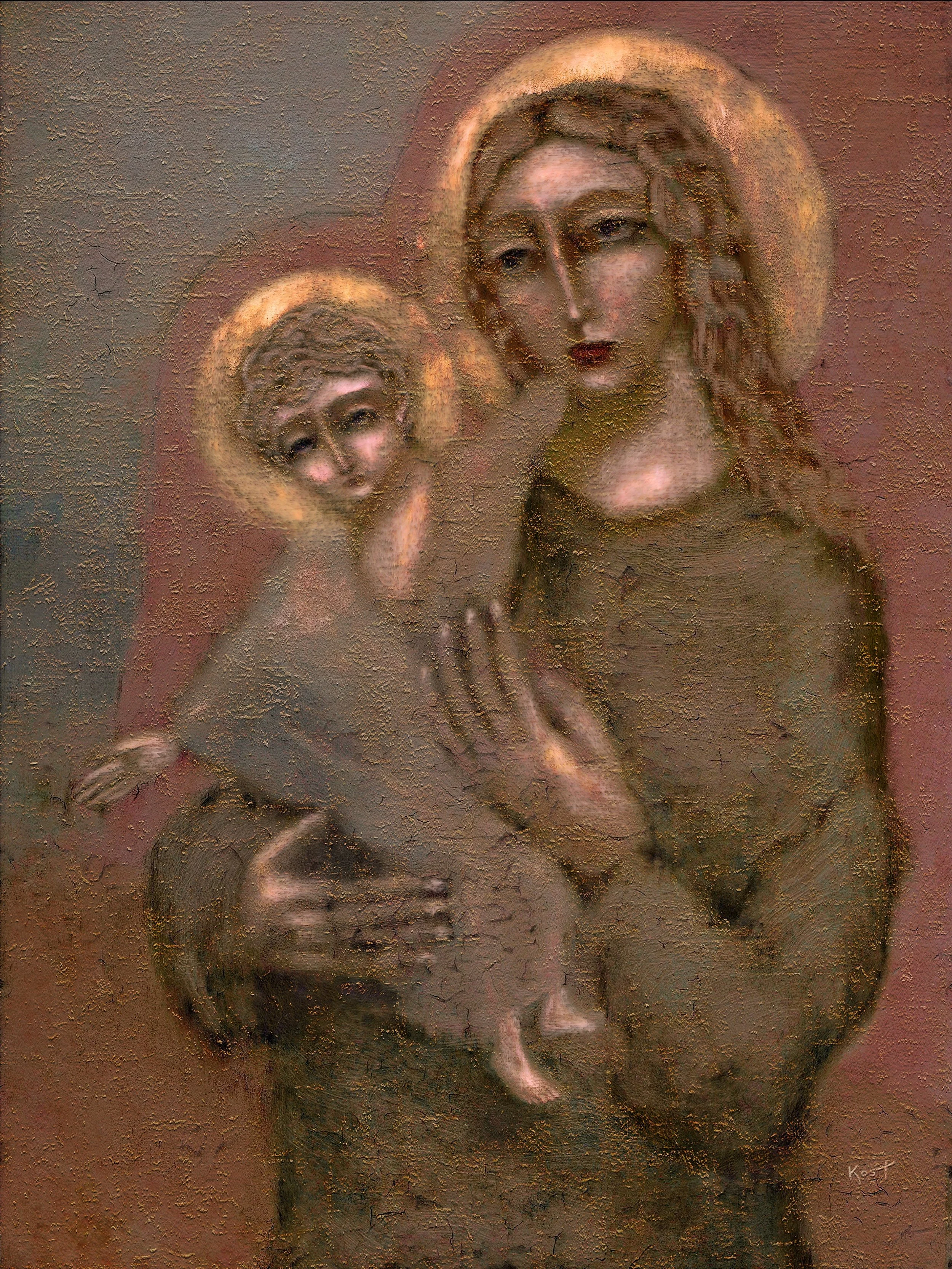
The Veil Between (2021-2025)
Archival Giclee print on 18”x24” heavyweight matte finish Hahnemühle German Etching Paper. This is a limited first edition hand-signed artwork.
In The Veil Between, Erik Stefan Kost offers a meditative reimagining of the Madonna and Child, situated at the threshold between Byzantine iconography and Renaissance humanism, filtered through the pathos of modern sacred expression. Executed entirely with his fingertips on a digital canvas, the image carries both the fragility of devotional panel painting and the immediacy of touch—intimate, direct, and reverent. The composition draws upon the Eleusa type of the Eastern Church, yet imbues it with a personal softness and psychological depth that resonates with the maternal figures of Fra Angelico or Giovanni Bellini, whose Madonnas, though serene, are never untouched by sorrow. Here, Kost deepens that sorrow into something quieter and more interior—a sacred ache.
The Madonna’s face is elongated and shadowed, her eyes downturned with foreknowledge. Her expression recalls not only the theological severity of early icons but the mournful clarity of Rogier van der Weyden’s Descent from the Cross, or the introspective melancholy of Bellini’s Pietà. She does not present a sanitized form of divine motherhood, but a woman burdened by both love and lament. The Christ Child, too, departs from the triumphant, golden infants of altarpieces. He is dense with symbolic weight, leaning into her not with playful trust but with solemn intimacy, his knowing gaze evoking the tragic prescience seen in Michelangelo’s Doni Tondo—where maternal joy is haunted by future sacrifice.
The digital surface, worn and mottled, feels less like a screen than a relic. Kost achieves a textural quality reminiscent of early tempera on panel, evoking the devotional patina of Giotto’s frescoes or the icon-like compositions of early Sienese painters such as Duccio. Yet Kost does not pursue Renaissance linear perspective or anatomical idealism. His space remains shallow, iconic, meditative. Like Fra Angelico’s frescoes in the San Marco convent, it invites not spectatorship but contemplation. Kost’s refusal to polish, his visible strokes and gentle erasures, enact a liturgy of presence: every mark touched, every contour considered. His technique becomes both prayer and method—a refusal of automation, a restoration of sacred labor.
It is in this context that protest subtly emerges—not as political outcry but as visual resistance. Kost resists the ornamental gloss of Western Marian idealization by grounding his figures in human vulnerability. He protests the digital world’s sterile perfectionism by introducing imperfection as a mark of incarnation. His Madonna, like Kollwitz’s grieving mothers or Michelangelo’s Mary in the Pietà, becomes a universal figure of lament, bearing witness to historical and contemporary suffering. This is a theology of embodiment—insisting, like the psalmists and prophets, that divinity is not found apart from sorrow but within it. That which is veiled is not absent, but sacred.
Ultimately, The Veil Between inhabits a lineage of sacred image-makers—from Byzantine monks and Renaissance mystics to Rouault, Chagall, and postwar modernists—who refused to separate beauty from grief. Kost’s image is neither icon nor portrait, but a threshold: a visual space in which the holy is not sanitized, but enfleshed. As in the works of Fra Angelico or Rembrandt’s late religious paintings, light here is not decorative but revelatory—it emanates from within. The viewer is invited not to decode, but to dwell—to pass through the veil into a space where suffering and sanctity are inseparable, and where the divine reveals itself through tenderness, touch, and silence.
Archival Giclee print on 18”x24” heavyweight matte finish Hahnemühle German Etching Paper. This is a limited first edition hand-signed artwork.
In The Veil Between, Erik Stefan Kost offers a meditative reimagining of the Madonna and Child, situated at the threshold between Byzantine iconography and Renaissance humanism, filtered through the pathos of modern sacred expression. Executed entirely with his fingertips on a digital canvas, the image carries both the fragility of devotional panel painting and the immediacy of touch—intimate, direct, and reverent. The composition draws upon the Eleusa type of the Eastern Church, yet imbues it with a personal softness and psychological depth that resonates with the maternal figures of Fra Angelico or Giovanni Bellini, whose Madonnas, though serene, are never untouched by sorrow. Here, Kost deepens that sorrow into something quieter and more interior—a sacred ache.
The Madonna’s face is elongated and shadowed, her eyes downturned with foreknowledge. Her expression recalls not only the theological severity of early icons but the mournful clarity of Rogier van der Weyden’s Descent from the Cross, or the introspective melancholy of Bellini’s Pietà. She does not present a sanitized form of divine motherhood, but a woman burdened by both love and lament. The Christ Child, too, departs from the triumphant, golden infants of altarpieces. He is dense with symbolic weight, leaning into her not with playful trust but with solemn intimacy, his knowing gaze evoking the tragic prescience seen in Michelangelo’s Doni Tondo—where maternal joy is haunted by future sacrifice.
The digital surface, worn and mottled, feels less like a screen than a relic. Kost achieves a textural quality reminiscent of early tempera on panel, evoking the devotional patina of Giotto’s frescoes or the icon-like compositions of early Sienese painters such as Duccio. Yet Kost does not pursue Renaissance linear perspective or anatomical idealism. His space remains shallow, iconic, meditative. Like Fra Angelico’s frescoes in the San Marco convent, it invites not spectatorship but contemplation. Kost’s refusal to polish, his visible strokes and gentle erasures, enact a liturgy of presence: every mark touched, every contour considered. His technique becomes both prayer and method—a refusal of automation, a restoration of sacred labor.
It is in this context that protest subtly emerges—not as political outcry but as visual resistance. Kost resists the ornamental gloss of Western Marian idealization by grounding his figures in human vulnerability. He protests the digital world’s sterile perfectionism by introducing imperfection as a mark of incarnation. His Madonna, like Kollwitz’s grieving mothers or Michelangelo’s Mary in the Pietà, becomes a universal figure of lament, bearing witness to historical and contemporary suffering. This is a theology of embodiment—insisting, like the psalmists and prophets, that divinity is not found apart from sorrow but within it. That which is veiled is not absent, but sacred.
Ultimately, The Veil Between inhabits a lineage of sacred image-makers—from Byzantine monks and Renaissance mystics to Rouault, Chagall, and postwar modernists—who refused to separate beauty from grief. Kost’s image is neither icon nor portrait, but a threshold: a visual space in which the holy is not sanitized, but enfleshed. As in the works of Fra Angelico or Rembrandt’s late religious paintings, light here is not decorative but revelatory—it emanates from within. The viewer is invited not to decode, but to dwell—to pass through the veil into a space where suffering and sanctity are inseparable, and where the divine reveals itself through tenderness, touch, and silence.