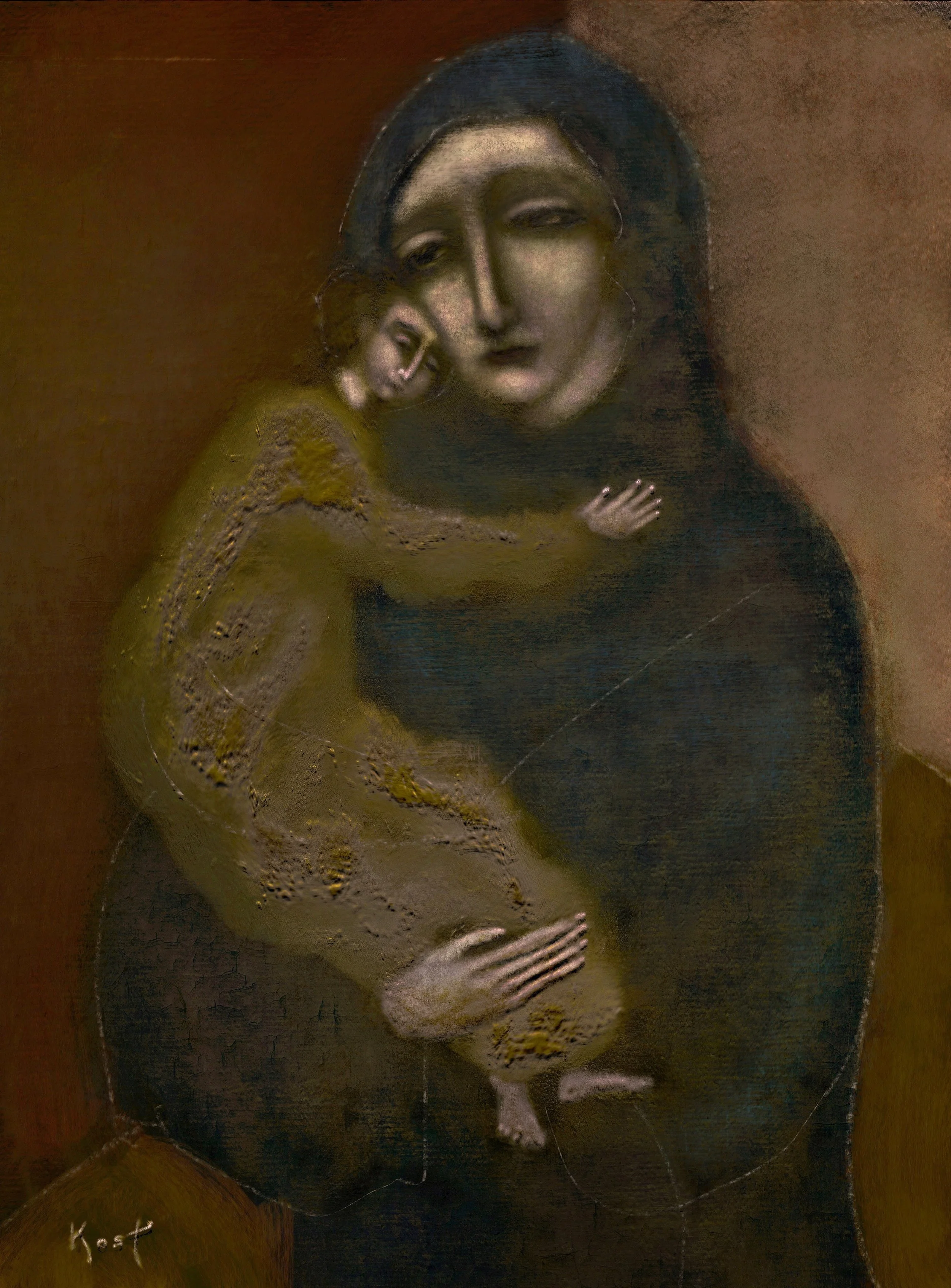
Madonna and Child, Florence (2024-2025)
Archival Giclee print on 18”x24” heavyweight matte finish Hahnemühle German Etching Paper. This is a limited first edition hand-signed artwork.
Madonna and Child, Florence is a work that fuses the gravitas of Byzantine and early Renaissance Marian imagery with a contemporary atmosphere of tenderness and fragility. The composition recalls the formal restraint of Tuscan devotional panels, where the Virgin is depicted in somber hues, cloaked in darkness that frames her illuminated face. Yet Kost’s interpretation diverges from traditional iconography, placing emphasis not on regal solemnity but on the quiet intimacy of touch, where mother and child merge into a single field of shadow, texture, and light. This duality—between inherited archetype and personal reinterpretation—marks the painting as both homage and innovation.
The work draws upon the Florentine tradition of the Madonna della Tenerezza, where the infant Christ presses his cheek to his mother’s, establishing not only theological symbolism but also emotional immediacy. The embrace here feels less like a stylized gesture and more like an act of mutual dependence, as if each figure leans upon the other for consolation. The Virgin’s elongated features, with her inward gaze and darkly framed eyes, carry the mournful foreknowledge of suffering, echoing Cimabue’s and Giotto’s early depictions of the Madonna. At the same time, the child’s elongated arms reach outward in an almost desperate grasp, suggesting the vulnerability of both divine and human love.
Kost’s treatment of texture plays a crucial role in deepening this resonance. The surfaces of the figures appear eroded, scarred, and weathered, as if formed from ancient plaster or fresco worn down by centuries of touch and time. This materiality connects the work to the tactile piety of Florentine chapels, where worshippers would reach out to images of the Virgin as mediators of comfort. The eroded quality of the forms suggests that such gestures have already taken place across history—that devotion itself has left marks upon the image. In this way, the painting becomes both object and memory, icon and relic.
There is also an unmistakable undercurrent of sorrow. The Madonna’s expression, tender yet shadowed, anticipates the grief of the Pietà, collapsing infancy and crucifixion into a single temporal moment. In her arms, the child is at once vulnerable infant and sacrificial offering, the embrace bearing the weight of both comfort and prophecy. The muted chromatic field, oscillating between earthen browns and shadowed blues, underscores this emotional ambiguity. What might otherwise be read as serene motherhood becomes instead a meditation on fragility, mortality, and the inseparability of love from suffering.
Viscerally, Madonna and Child, Florence feels both intimate and monumental. The viewer is drawn into the quiet embrace, sensing its warmth and vulnerability, yet simultaneously aware of its monumental stillness. The painting does not present a narrative but rather a suspended moment of eternal resonance, as if echoing from within a chapel wall. In this stillness, Kost reclaims the archetype of the Madonna and Child not as distant symbol but as lived human encounter, transfigured by memory, sorrow, and faith. It is an image that whispers of consolation while carrying within it the heavy silence of destiny.
Archival Giclee print on 18”x24” heavyweight matte finish Hahnemühle German Etching Paper. This is a limited first edition hand-signed artwork.
Madonna and Child, Florence is a work that fuses the gravitas of Byzantine and early Renaissance Marian imagery with a contemporary atmosphere of tenderness and fragility. The composition recalls the formal restraint of Tuscan devotional panels, where the Virgin is depicted in somber hues, cloaked in darkness that frames her illuminated face. Yet Kost’s interpretation diverges from traditional iconography, placing emphasis not on regal solemnity but on the quiet intimacy of touch, where mother and child merge into a single field of shadow, texture, and light. This duality—between inherited archetype and personal reinterpretation—marks the painting as both homage and innovation.
The work draws upon the Florentine tradition of the Madonna della Tenerezza, where the infant Christ presses his cheek to his mother’s, establishing not only theological symbolism but also emotional immediacy. The embrace here feels less like a stylized gesture and more like an act of mutual dependence, as if each figure leans upon the other for consolation. The Virgin’s elongated features, with her inward gaze and darkly framed eyes, carry the mournful foreknowledge of suffering, echoing Cimabue’s and Giotto’s early depictions of the Madonna. At the same time, the child’s elongated arms reach outward in an almost desperate grasp, suggesting the vulnerability of both divine and human love.
Kost’s treatment of texture plays a crucial role in deepening this resonance. The surfaces of the figures appear eroded, scarred, and weathered, as if formed from ancient plaster or fresco worn down by centuries of touch and time. This materiality connects the work to the tactile piety of Florentine chapels, where worshippers would reach out to images of the Virgin as mediators of comfort. The eroded quality of the forms suggests that such gestures have already taken place across history—that devotion itself has left marks upon the image. In this way, the painting becomes both object and memory, icon and relic.
There is also an unmistakable undercurrent of sorrow. The Madonna’s expression, tender yet shadowed, anticipates the grief of the Pietà, collapsing infancy and crucifixion into a single temporal moment. In her arms, the child is at once vulnerable infant and sacrificial offering, the embrace bearing the weight of both comfort and prophecy. The muted chromatic field, oscillating between earthen browns and shadowed blues, underscores this emotional ambiguity. What might otherwise be read as serene motherhood becomes instead a meditation on fragility, mortality, and the inseparability of love from suffering.
Viscerally, Madonna and Child, Florence feels both intimate and monumental. The viewer is drawn into the quiet embrace, sensing its warmth and vulnerability, yet simultaneously aware of its monumental stillness. The painting does not present a narrative but rather a suspended moment of eternal resonance, as if echoing from within a chapel wall. In this stillness, Kost reclaims the archetype of the Madonna and Child not as distant symbol but as lived human encounter, transfigured by memory, sorrow, and faith. It is an image that whispers of consolation while carrying within it the heavy silence of destiny.