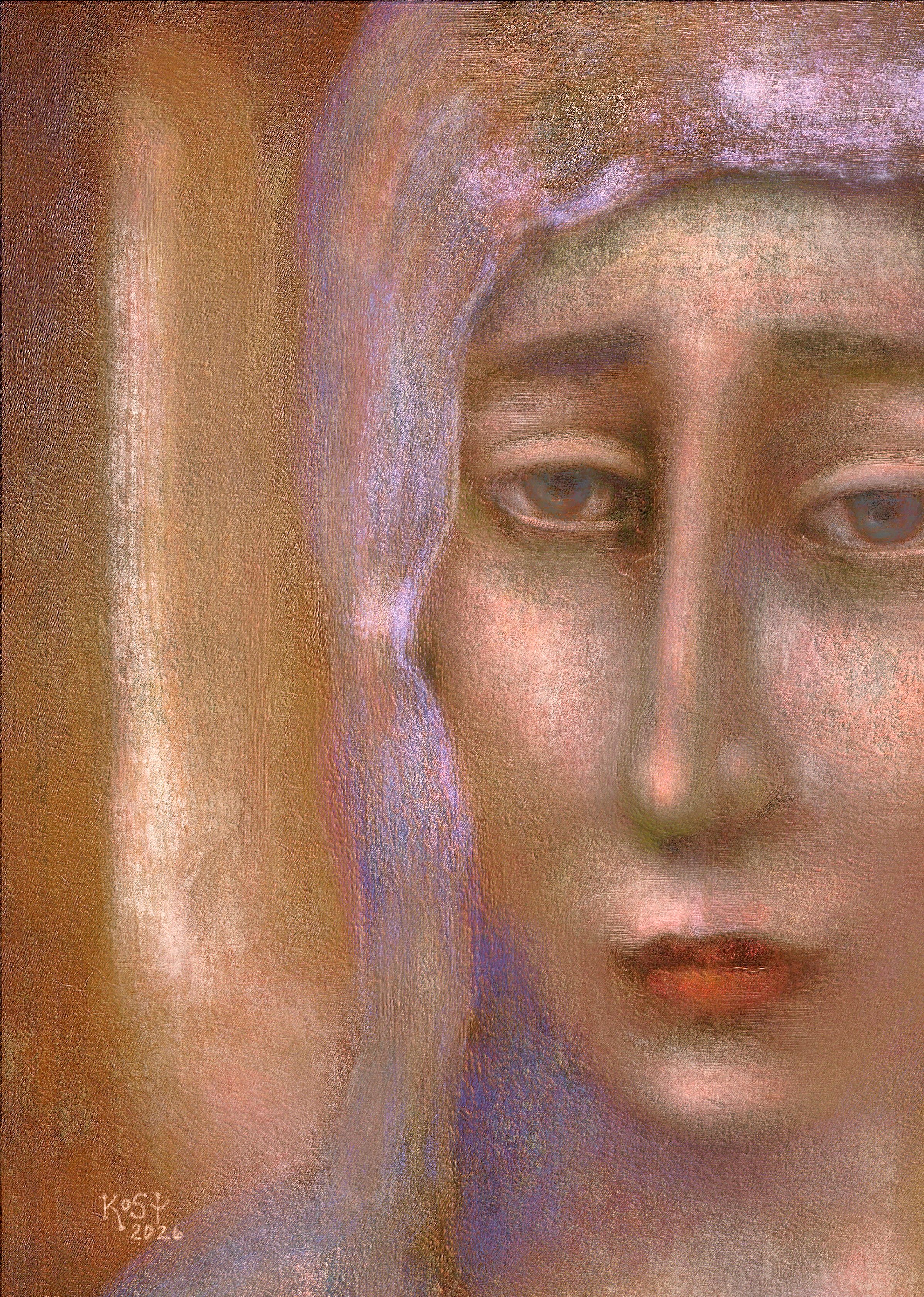
The Annunciation (2022-2026)
Archival Giclee print on 18”x24” heavyweight matte finish Hahnemühle German Etching Paper. This is a limited first edition hand-signed artwork.
The Annunciation presents a quiet, intimate moment that feels both ancient and immediate. The composition presses closely into the figure’s face, drawing attention to the eyes, the bridge of the nose, and the softly parted lips. This proximity creates a heightened sense of encounter—what we are given is not a distant scene, but a moment unfolding at the threshold of awareness.
The figure fills the frame almost entirely, her face emerging softly from a warm, earthen field of color. Her skin is rendered in gentle layers—muted reds, browns, and pale light—so that it seems to glow from within rather than reflect light from outside. Her eyes are open but heavy, not fixed on anything specific, as if she is looking inward as much as outward. Her lips are slightly parted, suggesting a breath held between understanding and uncertainty.
A translucent veil drapes over her head, barely distinguishable from the background. It dissolves into the surrounding space, blurring the boundary between figure and atmosphere. The edges of her face and shoulders are not sharply defined; instead, they soften and fade, as though she is still forming or being revealed. The surface itself carries a visible texture—like worn canvas or aged plaster—which gives the image a sense of time passing across it, as if it has been touched, weathered, and remembered.
The composition is simple, but deliberate. There are no clear symbols, no angel, no setting to anchor the moment in narrative. Instead, the announcement is internalized. It happens in stillness, in the subtle shift of expression, in the quiet tension of a face becoming aware of something larger than itself. Kost seems here to draw on his background as a photographer, employing a kind of cinematic close-up—where framing becomes a tool not just of composition, but of emotion. By isolating the face so closely, the image heightens psychological depth, allowing the smallest inflection to carry meaning.
Stylistically, the work draws from several points in art history while remaining restrained and contemporary. The softness of form and the emotional inwardness recall the portraiture of the High Renaissance, where balance and calm presence carried spiritual weight. At the same time, the blurred edges and atmospheric handling of light echo Impressionism, where perception and feeling take precedence over strict clarity. There is also a quiet kinship with Symbolism, in which meaning is suggested rather than declared, and the visible world points toward something beyond itself.
The Annunciation is not about spectacle or certainty. It speaks to the moment before understanding fully arrives—the pause where something sacred is sensed but not yet grasped. It invites the viewer into that same space of stillness, where meaning is not imposed, but slowly revealed.
Archival Giclee print on 18”x24” heavyweight matte finish Hahnemühle German Etching Paper. This is a limited first edition hand-signed artwork.
The Annunciation presents a quiet, intimate moment that feels both ancient and immediate. The composition presses closely into the figure’s face, drawing attention to the eyes, the bridge of the nose, and the softly parted lips. This proximity creates a heightened sense of encounter—what we are given is not a distant scene, but a moment unfolding at the threshold of awareness.
The figure fills the frame almost entirely, her face emerging softly from a warm, earthen field of color. Her skin is rendered in gentle layers—muted reds, browns, and pale light—so that it seems to glow from within rather than reflect light from outside. Her eyes are open but heavy, not fixed on anything specific, as if she is looking inward as much as outward. Her lips are slightly parted, suggesting a breath held between understanding and uncertainty.
A translucent veil drapes over her head, barely distinguishable from the background. It dissolves into the surrounding space, blurring the boundary between figure and atmosphere. The edges of her face and shoulders are not sharply defined; instead, they soften and fade, as though she is still forming or being revealed. The surface itself carries a visible texture—like worn canvas or aged plaster—which gives the image a sense of time passing across it, as if it has been touched, weathered, and remembered.
The composition is simple, but deliberate. There are no clear symbols, no angel, no setting to anchor the moment in narrative. Instead, the announcement is internalized. It happens in stillness, in the subtle shift of expression, in the quiet tension of a face becoming aware of something larger than itself. Kost seems here to draw on his background as a photographer, employing a kind of cinematic close-up—where framing becomes a tool not just of composition, but of emotion. By isolating the face so closely, the image heightens psychological depth, allowing the smallest inflection to carry meaning.
Stylistically, the work draws from several points in art history while remaining restrained and contemporary. The softness of form and the emotional inwardness recall the portraiture of the High Renaissance, where balance and calm presence carried spiritual weight. At the same time, the blurred edges and atmospheric handling of light echo Impressionism, where perception and feeling take precedence over strict clarity. There is also a quiet kinship with Symbolism, in which meaning is suggested rather than declared, and the visible world points toward something beyond itself.
The Annunciation is not about spectacle or certainty. It speaks to the moment before understanding fully arrives—the pause where something sacred is sensed but not yet grasped. It invites the viewer into that same space of stillness, where meaning is not imposed, but slowly revealed.