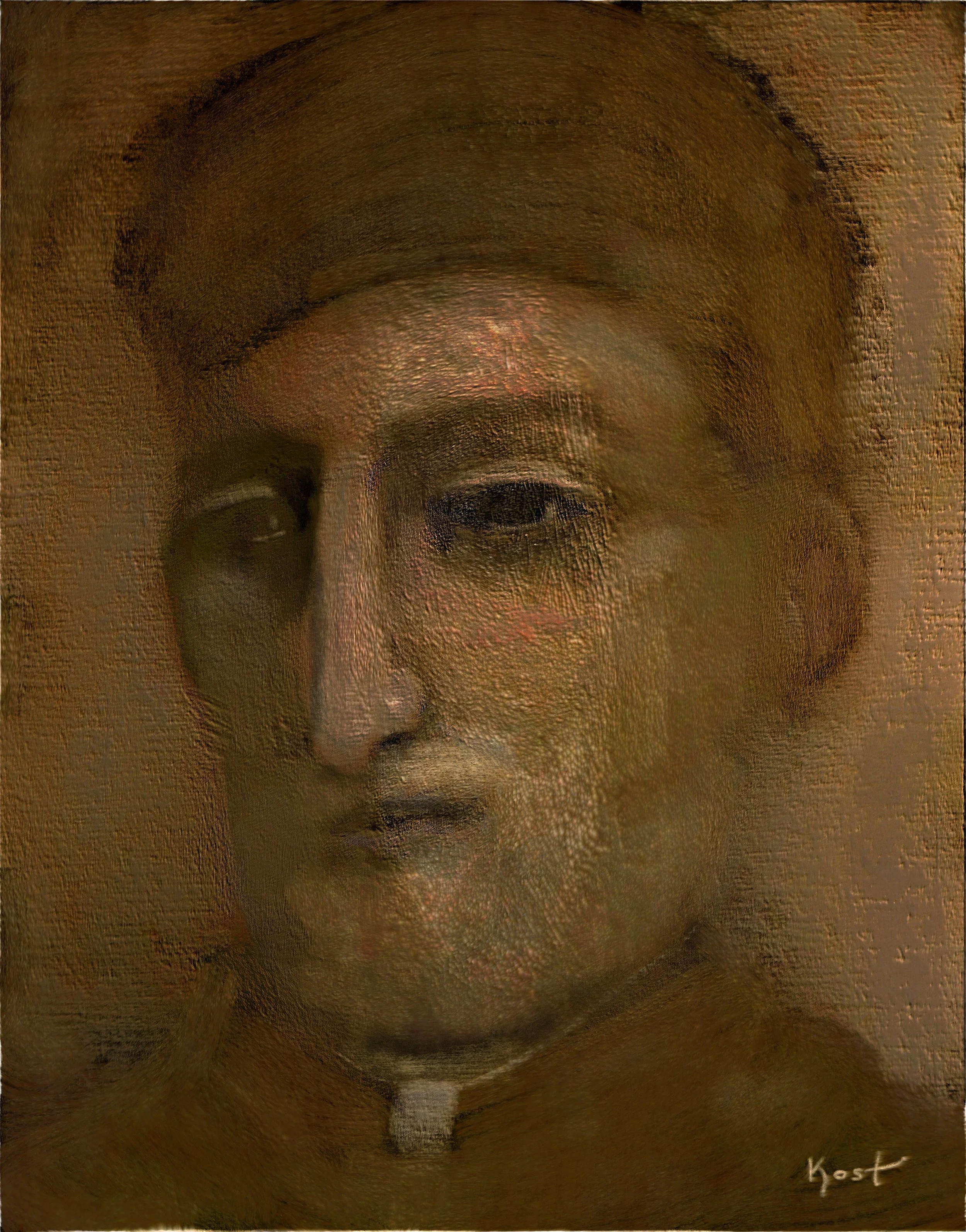
The Partisan (2022-2025)
Archival Giclee print on 18”x24” heavyweight matte finish Hahnemühle German Etching Paper. This is a limited first edition hand-signed artwork.
The Partisan is a work suffused with haunting solemnity, drawing upon the intertwined legacies of martyrdom, resistance, and memory. Its surface—textured, weathered, and veiled in shadow—evokes the patina of ancient iconography, yet it is not merely devotional. Instead, it carries with it the echoes of twentieth-century repression, particularly the brutal silencing of Catholic priests and underground faithful in Soviet Ukraine, many of whom were imprisoned, executed, or erased from history by the machinery of the KGB. The face that emerges from the obscurity of the canvas is neither portrait nor idealization, but a presence—an amalgam of the countless anonymous figures who stood their ground against tyranny and whose steadfastness endures as both wound and witness.
The downward cast of the figure’s eyes and the muted palette contribute to an atmosphere of mournful resilience. The subdued earth tones recall the faded murals of monasteries scarred by time and violence, while the heavy shadows suggest a consciousness pressed beneath the weight of history. Yet within the figure’s gaze lies something unbroken—a quiet fire that resists erasure. This paradox, the coexistence of sorrow and strength, places the work within the lineage of resistance art, where beauty is sharpened not by triumph but by endurance. The texture of the surface itself, almost scarred with striations, resembles both the weathered face of a relic and the visceral memory of a body bearing its marks.
Kost acknowledges a profound influence from Leonard Cohen’s song The Partisan. Cohen’s lyrics, themselves rooted in the history of World War II resistance, articulate the duality of exile and perseverance, grief and companionship. His lament—“I have lost my wife and children, but I have many friends”—finds a visual counterpart in the painting, where sorrow and solidarity intertwine. Cohen’s blend of mournful lyricism and unyielding dignity left a deep impression on Kost, who sought to embody that spirit in painterly form. In this way, the figure depicted becomes not one individual but an emblem of many, resonating across past martyrs, Cohen’s poetic testimony, and the ongoing struggles in contemporary Ukraine.
The piece also inhabits the paradox of partisanship itself: defiance that is born not from aggression but from refusal—to be silenced, erased, or spiritually annihilated. There is a theological dimension here that transcends political resistance. The subdued luminosity of the face, faintly haloed by shadow, recalls the quiet radiance of saints’ icons, aligning the partisan with martyrdom. To resist is to testify, to give witness in the ancient Christian sense of martyria. In this way, the work collapses the sacred and the political into a single visual theology of witness.
Viscerally, the image unsettles. One cannot look upon The Partisan without sensing the silence that follows terror, the stillness of someone waiting, hiding, or praying in secret. It feels both intimate and monumental, like a whisper heard within a cathedral ruin. The surface draws the viewer close, into the grain of its textures, as if listening to the murmurs of memory within stone. At the same time, the figure withdraws, shrouded and elusive, never yielding a full sense of self. In this tension, the work becomes both elegy and summons: a reminder that resistance is not only an act of war but also an act of faith, an insistence upon human dignity in the face of erasure.
Archival Giclee print on 18”x24” heavyweight matte finish Hahnemühle German Etching Paper. This is a limited first edition hand-signed artwork.
The Partisan is a work suffused with haunting solemnity, drawing upon the intertwined legacies of martyrdom, resistance, and memory. Its surface—textured, weathered, and veiled in shadow—evokes the patina of ancient iconography, yet it is not merely devotional. Instead, it carries with it the echoes of twentieth-century repression, particularly the brutal silencing of Catholic priests and underground faithful in Soviet Ukraine, many of whom were imprisoned, executed, or erased from history by the machinery of the KGB. The face that emerges from the obscurity of the canvas is neither portrait nor idealization, but a presence—an amalgam of the countless anonymous figures who stood their ground against tyranny and whose steadfastness endures as both wound and witness.
The downward cast of the figure’s eyes and the muted palette contribute to an atmosphere of mournful resilience. The subdued earth tones recall the faded murals of monasteries scarred by time and violence, while the heavy shadows suggest a consciousness pressed beneath the weight of history. Yet within the figure’s gaze lies something unbroken—a quiet fire that resists erasure. This paradox, the coexistence of sorrow and strength, places the work within the lineage of resistance art, where beauty is sharpened not by triumph but by endurance. The texture of the surface itself, almost scarred with striations, resembles both the weathered face of a relic and the visceral memory of a body bearing its marks.
Kost acknowledges a profound influence from Leonard Cohen’s song The Partisan. Cohen’s lyrics, themselves rooted in the history of World War II resistance, articulate the duality of exile and perseverance, grief and companionship. His lament—“I have lost my wife and children, but I have many friends”—finds a visual counterpart in the painting, where sorrow and solidarity intertwine. Cohen’s blend of mournful lyricism and unyielding dignity left a deep impression on Kost, who sought to embody that spirit in painterly form. In this way, the figure depicted becomes not one individual but an emblem of many, resonating across past martyrs, Cohen’s poetic testimony, and the ongoing struggles in contemporary Ukraine.
The piece also inhabits the paradox of partisanship itself: defiance that is born not from aggression but from refusal—to be silenced, erased, or spiritually annihilated. There is a theological dimension here that transcends political resistance. The subdued luminosity of the face, faintly haloed by shadow, recalls the quiet radiance of saints’ icons, aligning the partisan with martyrdom. To resist is to testify, to give witness in the ancient Christian sense of martyria. In this way, the work collapses the sacred and the political into a single visual theology of witness.
Viscerally, the image unsettles. One cannot look upon The Partisan without sensing the silence that follows terror, the stillness of someone waiting, hiding, or praying in secret. It feels both intimate and monumental, like a whisper heard within a cathedral ruin. The surface draws the viewer close, into the grain of its textures, as if listening to the murmurs of memory within stone. At the same time, the figure withdraws, shrouded and elusive, never yielding a full sense of self. In this tension, the work becomes both elegy and summons: a reminder that resistance is not only an act of war but also an act of faith, an insistence upon human dignity in the face of erasure.