Archival Giclee print on 18”x24” heavyweight matte finish Hahnemühle German Etching Paper. This is a limited first edition hand-signed artwork.
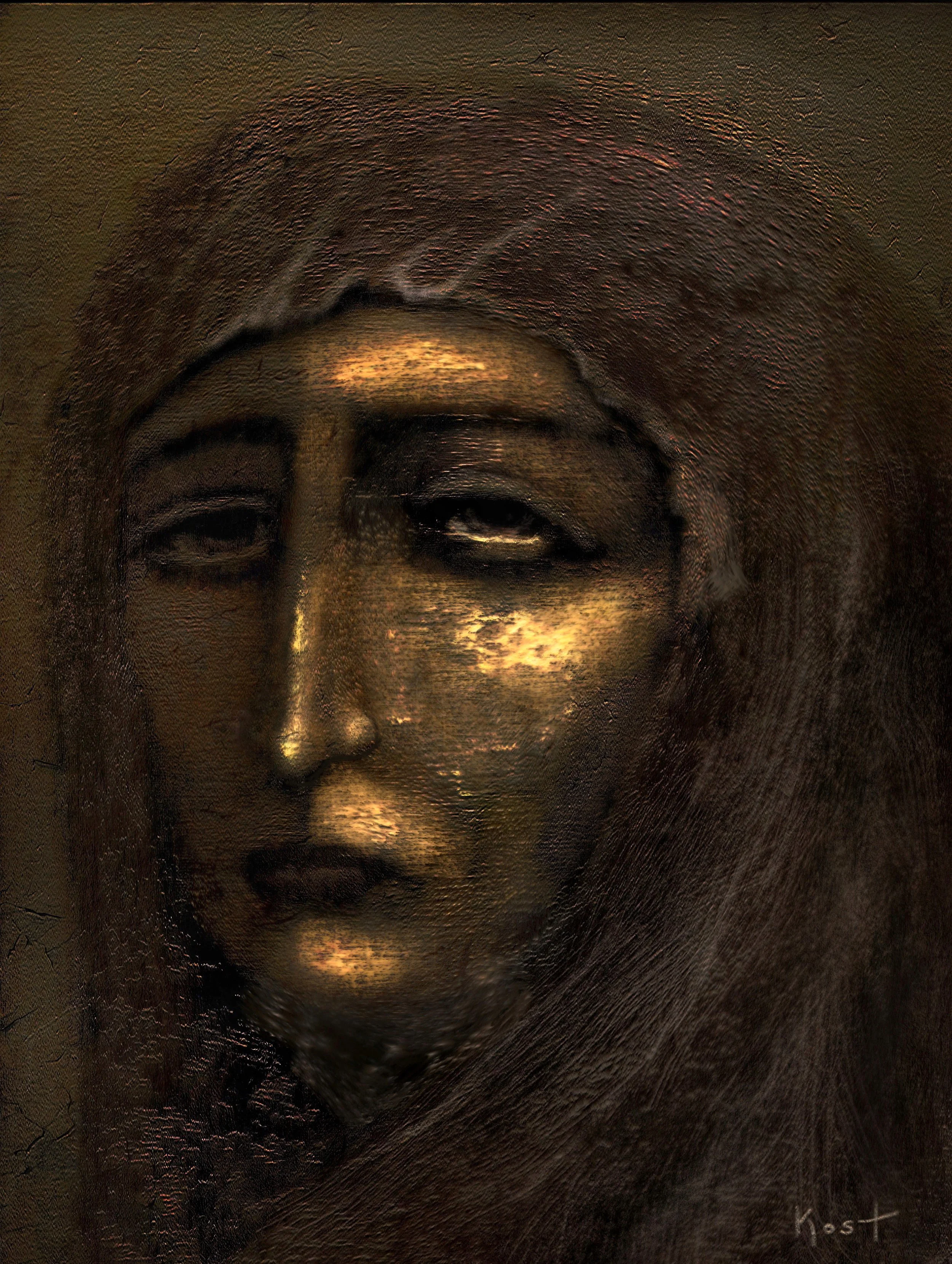
In Golgotha, the human face emerges from darkness like a relic of suffering unearthed from centuries past — cracked, eroded, and yet unyielding. It is not a portrait but an embodiment: the distilled presence of one who stood beneath the Cross, unable to turn away as love was crucified. The figure is both witness and mirror, bearing the weight of sorrow too vast to speak, its silence deeper than any cry.
Light and shadow are not mere technique here but language. A faint glimmer across the brow and cheek suggests grace clinging stubbornly to despair, while darkness presses in like the tomb itself. This tension recalls the chiaroscuro of early photography and the searching close-ups of Ingmar Bergman, where the human face becomes a terrain of metaphysical struggle. The image holds the viewer as Bergman’s camera does — refusing distraction, demanding that we dwell within its stillness and reckon with what we see.
The title anchors it in the “place of the skull,” yet Golgotha speaks far beyond that hill. It becomes a meditation on the crucifixions of every age — the devastations of war, the desolations of illness, the private nights of the soul that shape us. There is something deeply Kazantzakian here: the conviction that suffering is not the end but the passage through which resurrection is made possible.
Viscerally, the work strikes like a blow — its cracked surface like ancient wood or scorched earth, its presence almost sculptural, as if carved by centuries of grief. And yet in the midst of this ruin, a fragile light endures, trembling but unextinguished. Golgotha is both lament and prayer, an icon of humanity’s most harrowing moments and the quiet, defiant hope that flickers even there.
Archival Giclee print on 18”x24” heavyweight matte finish Hahnemühle German Etching Paper. This is a limited first edition hand-signed artwork.
In Golgotha, the human face emerges from darkness like a relic of suffering unearthed from centuries past — cracked, eroded, and yet unyielding. It is not a portrait but an embodiment: the distilled presence of one who stood beneath the Cross, unable to turn away as love was crucified. The figure is both witness and mirror, bearing the weight of sorrow too vast to speak, its silence deeper than any cry.
Light and shadow are not mere technique here but language. A faint glimmer across the brow and cheek suggests grace clinging stubbornly to despair, while darkness presses in like the tomb itself. This tension recalls the chiaroscuro of early photography and the searching close-ups of Ingmar Bergman, where the human face becomes a terrain of metaphysical struggle. The image holds the viewer as Bergman’s camera does — refusing distraction, demanding that we dwell within its stillness and reckon with what we see.
The title anchors it in the “place of the skull,” yet Golgotha speaks far beyond that hill. It becomes a meditation on the crucifixions of every age — the devastations of war, the desolations of illness, the private nights of the soul that shape us. There is something deeply Kazantzakian here: the conviction that suffering is not the end but the passage through which resurrection is made possible.
Viscerally, the work strikes like a blow — its cracked surface like ancient wood or scorched earth, its presence almost sculptural, as if carved by centuries of grief. And yet in the midst of this ruin, a fragile light endures, trembling but unextinguished. Golgotha is both lament and prayer, an icon of humanity’s most harrowing moments and the quiet, defiant hope that flickers even there.