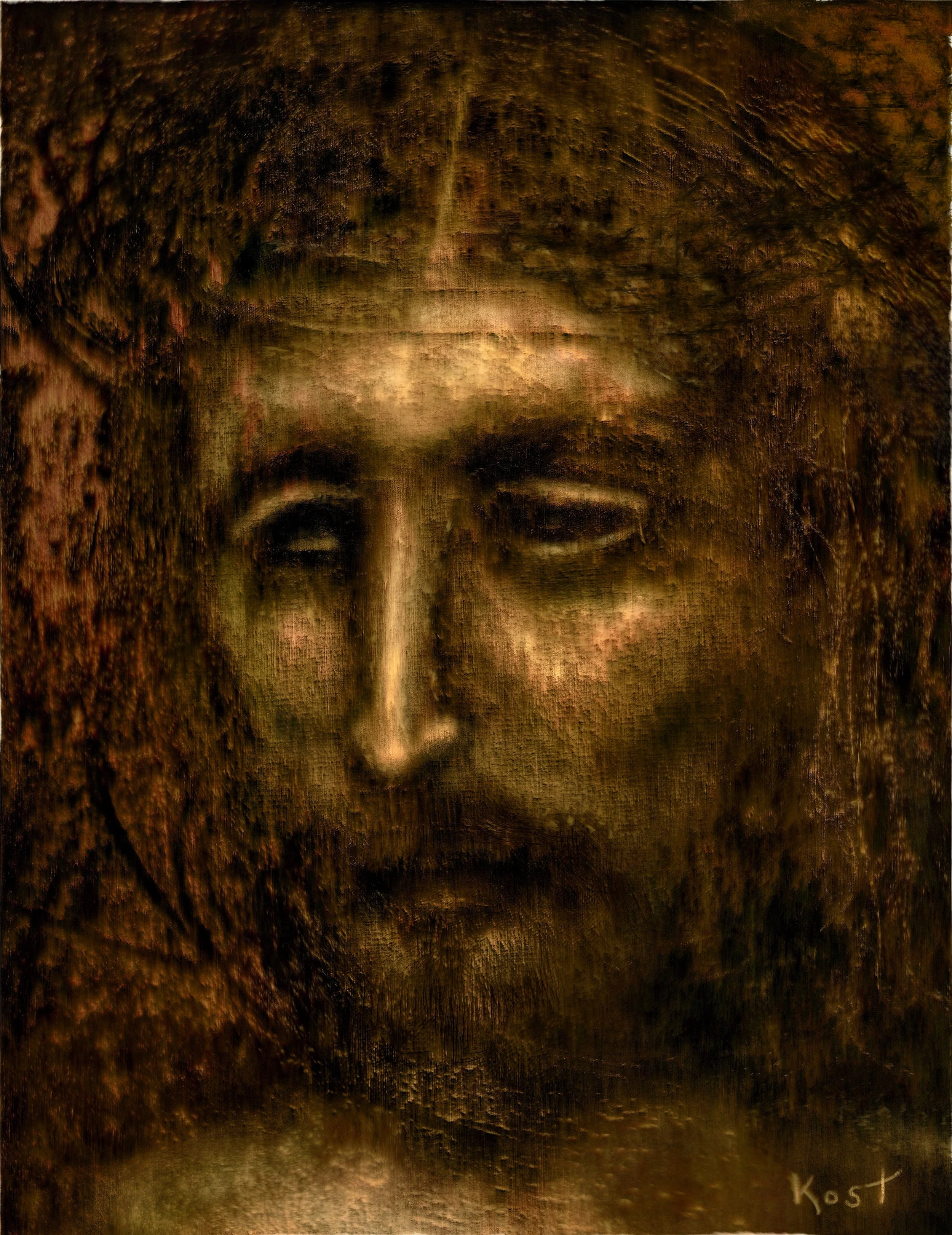
Passion (2022-2025)
Archival Giclee print on 18”x24” heavyweight matte finish Hahnemühle German Etching Paper. This is a limited first edition hand-signed artwork.
Kost’s Passion presents a haunting image of Christ emerging from shadow and deep gold tones, evoking the sacred mystery of suffering and transcendence. The work draws from the Byzantine tradition of acheiropoieta—icons believed to be “not made by human hands,” such as the Mandylion or the Veil of Veronica—while also softening their strict, formal structure with modern expression. The face appears both worn and illuminated, as though time itself has left its mark upon it. Unlike the sharp lines of traditional iconography, Kost blurs and softens the features, suggesting a presence revealed through decay, absence, and memory. In this way, the work speaks not only to Orthodox icon painting but also to the Renaissance technique of sfumato, where forms gently dissolve into atmosphere.
The use of gold and deep earth tones places Passion within the long tradition of sacred art that seeks to connect the physical and spiritual worlds. The painting recalls devotional images by artists like Cimabue or Giotto, who used muted tones to bring divinity closer to human experience. Yet here, Kost moves further into dramatic light and shadow, bringing the work closer to the emotional depth found in Rembrandt’s late portraits or Georges Rouault’s spiritual figures, where light emerges from suffering itself rather than heavenly glory. The textured surface suggests both wounds and sanctification, as if the image itself has endured the violence of the Passion.
What sets Passion apart from earlier sacred images is its embrace of ambiguity. Traditional icons clearly define Christ’s features, but Kost presents them as partially hidden, as though fading into memory or emerging from eternity. The lowered, shadowed eyes avoid direct contact, deepening the sense of mystery. This approach recalls Francis Bacon’s blurred portraits, where identity becomes uncertain, yet Kost redirects this uncertainty toward spiritual meaning rather than despair. In this way, the work reflects a theology of hiddenness, aligning with traditions that understand God as ultimately beyond full human comprehension.
On an emotional level, the painting creates both intimacy and unease. The viewer is drawn into the solemn gravity of Christ’s presence—or rather, His refusal to meet the viewer’s gaze—confronting not comfort but suffering transformed into holiness. The textured layers and gold tones suggest both age and the burning intensity of crucifixion. The silence of the face feels almost physical, lingering beyond the moment of viewing. This depth of sensation turns the work into more than an image to observe—it becomes something to endure, unsettling even as it consoles.
Ultimately, Passion places Kost’s work within a tradition of sacred art that refuses to separate transcendence from human vulnerability. Its layered surface and obscured face create a dialogue between Byzantine icons and modern portraiture, bringing past and present together in a single powerful image. The work echoes the timeless seriousness found in Rouault’s Miserere series or El Greco’s saints, while remaining distinctly contemporary in its texture and approach. It stands as a witness not only to Christ’s suffering but also to the fragility of faith itself, asking the viewer not simply to look, but to wrestle with mystery, silence, and presence.
Archival Giclee print on 18”x24” heavyweight matte finish Hahnemühle German Etching Paper. This is a limited first edition hand-signed artwork.
Kost’s Passion presents a haunting image of Christ emerging from shadow and deep gold tones, evoking the sacred mystery of suffering and transcendence. The work draws from the Byzantine tradition of acheiropoieta—icons believed to be “not made by human hands,” such as the Mandylion or the Veil of Veronica—while also softening their strict, formal structure with modern expression. The face appears both worn and illuminated, as though time itself has left its mark upon it. Unlike the sharp lines of traditional iconography, Kost blurs and softens the features, suggesting a presence revealed through decay, absence, and memory. In this way, the work speaks not only to Orthodox icon painting but also to the Renaissance technique of sfumato, where forms gently dissolve into atmosphere.
The use of gold and deep earth tones places Passion within the long tradition of sacred art that seeks to connect the physical and spiritual worlds. The painting recalls devotional images by artists like Cimabue or Giotto, who used muted tones to bring divinity closer to human experience. Yet here, Kost moves further into dramatic light and shadow, bringing the work closer to the emotional depth found in Rembrandt’s late portraits or Georges Rouault’s spiritual figures, where light emerges from suffering itself rather than heavenly glory. The textured surface suggests both wounds and sanctification, as if the image itself has endured the violence of the Passion.
What sets Passion apart from earlier sacred images is its embrace of ambiguity. Traditional icons clearly define Christ’s features, but Kost presents them as partially hidden, as though fading into memory or emerging from eternity. The lowered, shadowed eyes avoid direct contact, deepening the sense of mystery. This approach recalls Francis Bacon’s blurred portraits, where identity becomes uncertain, yet Kost redirects this uncertainty toward spiritual meaning rather than despair. In this way, the work reflects a theology of hiddenness, aligning with traditions that understand God as ultimately beyond full human comprehension.
On an emotional level, the painting creates both intimacy and unease. The viewer is drawn into the solemn gravity of Christ’s presence—or rather, His refusal to meet the viewer’s gaze—confronting not comfort but suffering transformed into holiness. The textured layers and gold tones suggest both age and the burning intensity of crucifixion. The silence of the face feels almost physical, lingering beyond the moment of viewing. This depth of sensation turns the work into more than an image to observe—it becomes something to endure, unsettling even as it consoles.
Ultimately, Passion places Kost’s work within a tradition of sacred art that refuses to separate transcendence from human vulnerability. Its layered surface and obscured face create a dialogue between Byzantine icons and modern portraiture, bringing past and present together in a single powerful image. The work echoes the timeless seriousness found in Rouault’s Miserere series or El Greco’s saints, while remaining distinctly contemporary in its texture and approach. It stands as a witness not only to Christ’s suffering but also to the fragility of faith itself, asking the viewer not simply to look, but to wrestle with mystery, silence, and presence.