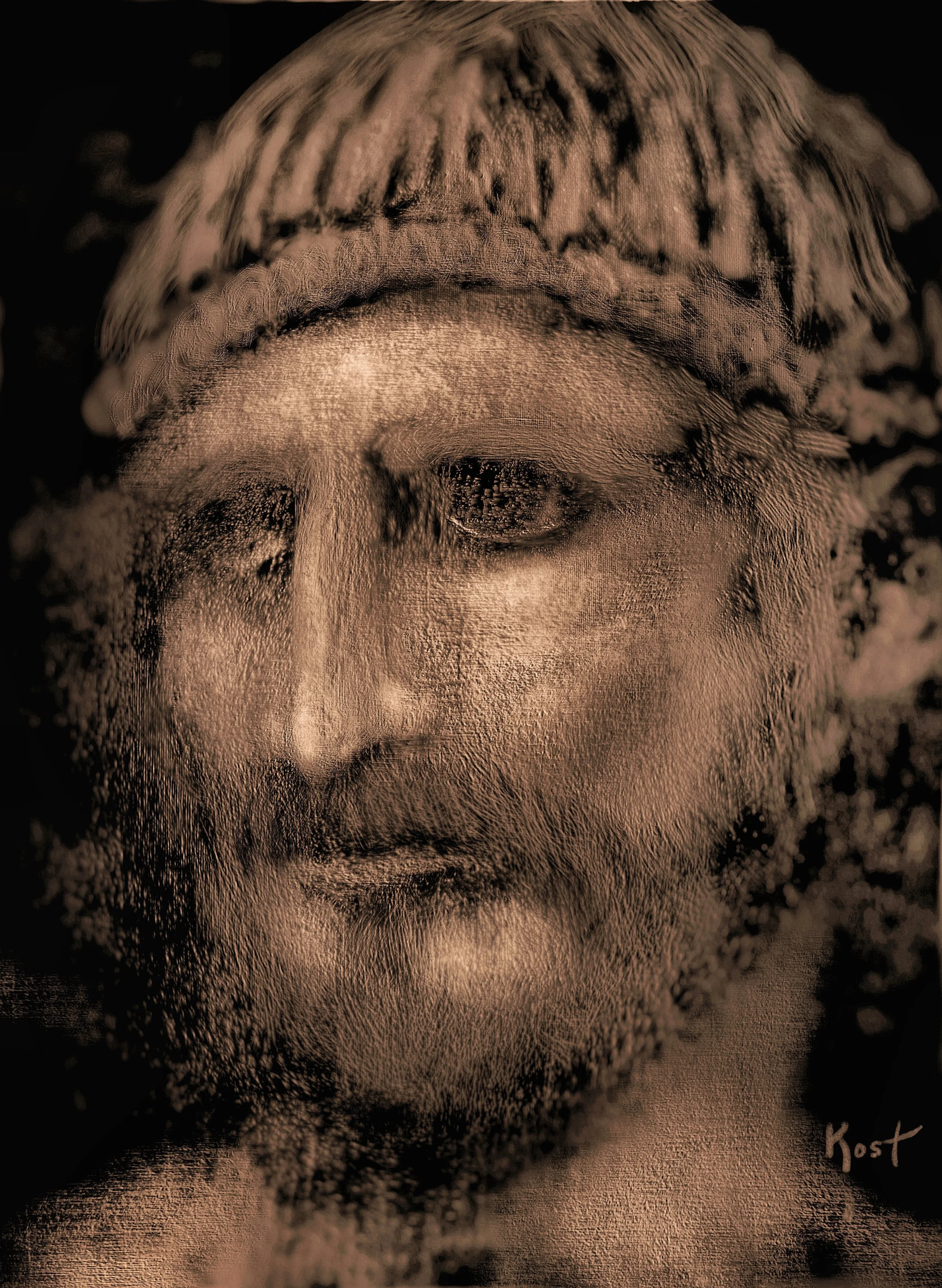
The Fisherman (2023-2026)
Archival Giclee print on 18”x24” heavyweight matte finish Hahnemühle German Etching Paper. This is a limited first edition hand-signed artwork.
The Fisherman draws on the enduring biblical image associated with figures like Jesus Christ and Saint Peter, but approaches it as an interior condition rather than a declared mission. The figure’s gaze is open and outward, yet it does not fully meet the viewer—it seems to pass through, as though fixed on something just beyond immediate sight. This creates a subtle tension: he is present, but not entirely here. The labor suggested is not physical action, but a sustained attentiveness to what lies beneath the surface of things.
At first glance, the image carries an almost photographic authority. Its tonal compression and subdued contrasts recall the visual language of early photographic processes, suggesting something captured rather than constructed. Here, Kost subtly draws on his background in photography, allowing the work to initially present itself as a document of reality. Yet this impression gradually unravels. The surface resists clarity—textures fracture, edges dissolve, and the image refuses to fully resolve. What seemed fixed becomes uncertain, shifting the work from record toward revelation, from evidence toward something more elusive and interior.
The image is rendered in a subdued, earthen palette that feels less painted than unearthed. Its textured surface carries a sense of erosion, as if the face has been worn into visibility over time. This treatment dissolves individual specificity, allowing the figure to function as an archetype rather than a portrait. He becomes a stand-in for a mode of being—one shaped by patience, endurance, and a quiet acceptance of uncertainty.
Stylistically, the work enters into dialogue with Byzantine iconography, particularly in its frontal composition and meditative stillness. Yet it resists the luminous clarity and formal resolution typical of traditional icons. Instead of gold ground and sharp delineation, The Fisherman inhabits a space of ambiguity, where form emerges gradually from shadow. In this way, it reinterprets the sacred image through a contemporary lens—one that acknowledges distance, fragmentation, and the difficulty of perceiving meaning with certainty.
There is also an echo of Renaissance art devotional studies in the work’s emphasis on human weight and presence. The face carries a quiet gravity, marked not by idealization but by lived experience. It suggests the long duration of waiting—the kind that defines both physical labor and spiritual searching. The fisherman here is not triumphant; he is enduring.
Ultimately, The Fisherman reflects a posture of sustained attention. It holds the space between knowing and not knowing, between what is visible and what remains concealed. The figure’s outward gaze invites the viewer into that same condition—one in which meaning is not immediately grasped, but slowly approached, with patience and restraint.
Archival Giclee print on 18”x24” heavyweight matte finish Hahnemühle German Etching Paper. This is a limited first edition hand-signed artwork.
The Fisherman draws on the enduring biblical image associated with figures like Jesus Christ and Saint Peter, but approaches it as an interior condition rather than a declared mission. The figure’s gaze is open and outward, yet it does not fully meet the viewer—it seems to pass through, as though fixed on something just beyond immediate sight. This creates a subtle tension: he is present, but not entirely here. The labor suggested is not physical action, but a sustained attentiveness to what lies beneath the surface of things.
At first glance, the image carries an almost photographic authority. Its tonal compression and subdued contrasts recall the visual language of early photographic processes, suggesting something captured rather than constructed. Here, Kost subtly draws on his background in photography, allowing the work to initially present itself as a document of reality. Yet this impression gradually unravels. The surface resists clarity—textures fracture, edges dissolve, and the image refuses to fully resolve. What seemed fixed becomes uncertain, shifting the work from record toward revelation, from evidence toward something more elusive and interior.
The image is rendered in a subdued, earthen palette that feels less painted than unearthed. Its textured surface carries a sense of erosion, as if the face has been worn into visibility over time. This treatment dissolves individual specificity, allowing the figure to function as an archetype rather than a portrait. He becomes a stand-in for a mode of being—one shaped by patience, endurance, and a quiet acceptance of uncertainty.
Stylistically, the work enters into dialogue with Byzantine iconography, particularly in its frontal composition and meditative stillness. Yet it resists the luminous clarity and formal resolution typical of traditional icons. Instead of gold ground and sharp delineation, The Fisherman inhabits a space of ambiguity, where form emerges gradually from shadow. In this way, it reinterprets the sacred image through a contemporary lens—one that acknowledges distance, fragmentation, and the difficulty of perceiving meaning with certainty.
There is also an echo of Renaissance art devotional studies in the work’s emphasis on human weight and presence. The face carries a quiet gravity, marked not by idealization but by lived experience. It suggests the long duration of waiting—the kind that defines both physical labor and spiritual searching. The fisherman here is not triumphant; he is enduring.
Ultimately, The Fisherman reflects a posture of sustained attention. It holds the space between knowing and not knowing, between what is visible and what remains concealed. The figure’s outward gaze invites the viewer into that same condition—one in which meaning is not immediately grasped, but slowly approached, with patience and restraint.